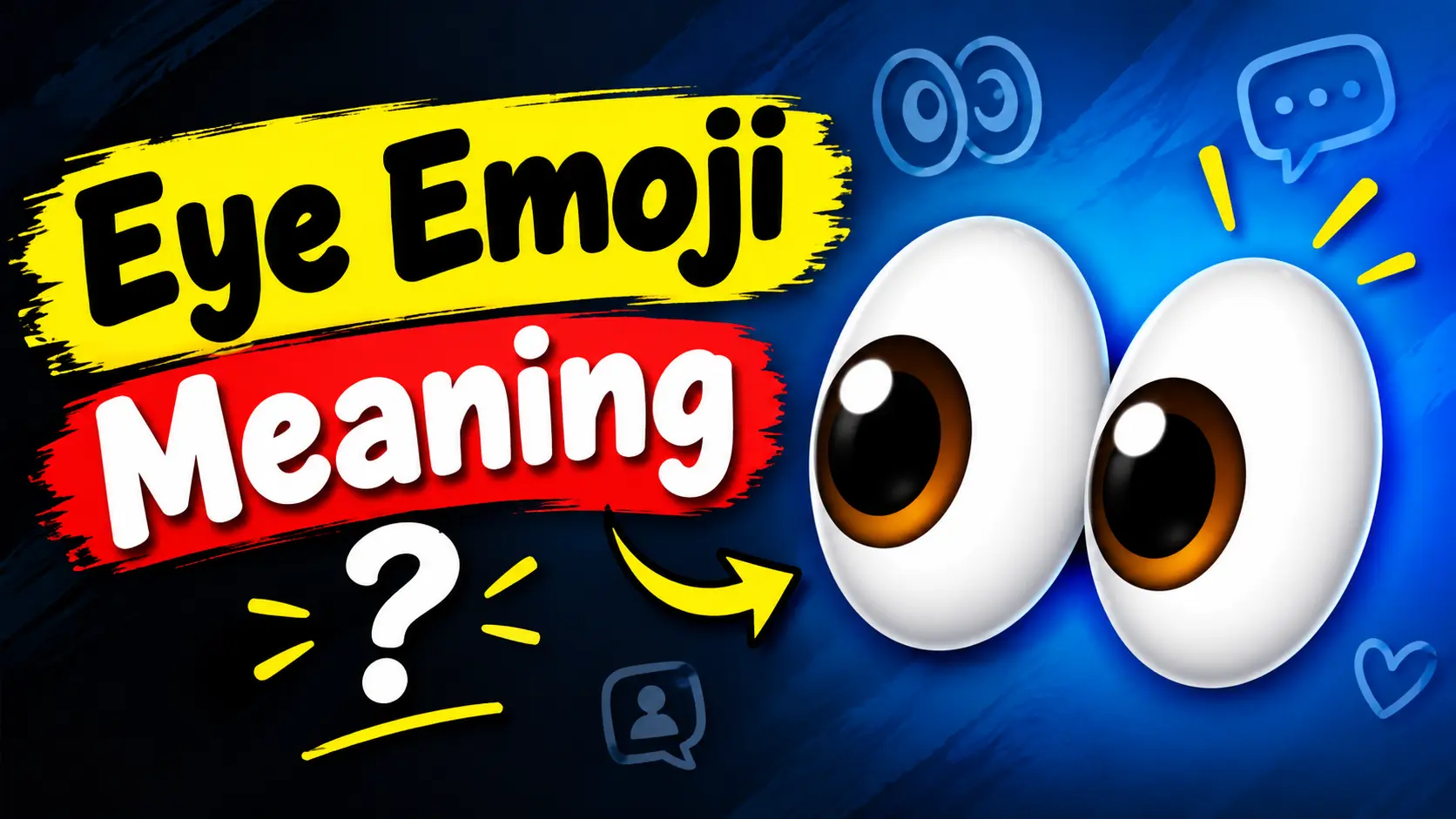
Certain emojis can say more than a full sentence, and the 👀 eye emoji is a perfect example. The Meaning of Eye Emoji 👀 can change dramatically depending on the conversation, making it one of the most interesting symbols used in texting and social media. It commonly represents watching, noticing, curiosity, attention, or wanting to see what happens next.
Someone may send 👀 when they are interested in a story, waiting for more details, or subtly reacting to something surprising. In playful conversations, it can also suggest that someone is teasing, flirting, or hinting that they noticed something interesting. The emoji may even communicate “I’m watching” without saying those exact words.
Context is important because the same 👀 can feel curious, funny, suspicious, or flirty depending on the message around it. In this guide, we’ll explain the Meaning of Eye Emoji 👀 in texting, social media, friendship, flirting, and different everyday situations.
Meaning & Definition
At its core, the eye emoji (👀) is used to signal that someone is watching, paying attention, or quietly observing a situation. It’s less about literal eyeballs and more about the feeling of being nosy, interested, or subtly alert.
Primary meaning: “I’m watching this” or “I see what’s happening here.” It’s often dropped into a conversation to show interest without committing to a full comment.
Secondary/alternative meanings:
- Flirtatious curiosity , a way of saying “I like what I see” 😏
- Suspicion or side-eye , “I’m keeping an eye on this situation”
- Anticipation , “waiting to see how this turns out”
- Gossip signal , “spill the tea, I’m listening”
Example messages:
- Friend: “So I might have texted my ex last night…” → Reply: 👀
- Post caption: “New merch drop coming Friday 👀” (building anticipation)
Background & Origin
The eye emoji itself has been part of the standard Unicode emoji set since the early days of emoji adoption, originally intended as a literal representation of a pair of eyes. Its meaning began to shift as internet culture repurposed visual symbols into shorthand reactions rather than literal descriptions.
As texting and social media commenting became faster-paced, users needed quick, wordless ways to react , a thumbs up for approval, a fire emoji for excitement, and 👀 for “I noticed this” or “tell me more.” Meme culture and Black Twitter (often credited with popularizing many modern emoji and slang usages) played a large role in turning 👀 into a stand-in for nosiness, suspicion, or playful interest, and from there it spread across mainstream platforms.
Usage in Different Contexts
Texting or chat messages: Used as a quick reaction to juicy or surprising news.
“Guess who got promoted? 👀”
Social media platforms: Used in captions or comments to tease upcoming content or react to a post without writing a full sentence.
Comment on a mysterious teaser post: “👀👀👀 what is this??”
Professional or technical settings: Occasionally used in more casual workplace chats (like Slack) to indicate someone has seen a message or is monitoring a thread, though it’s rare in formal emails.
Slack message: “Can someone review this doc before EOD?” → Reply: 👀 (meaning “on it, taking a look”)
Platform-Specific Meanings
| Platform | Common Meaning | Example Use |
| Casual acknowledgment or curiosity in group chats | “Party’s at 9 👀” | |
| Teasing followers about upcoming posts or reels | “New collab dropping soon 👀” | |
| TikTok | Reacting to plot twists or surprising content in comments | “Wait till the end 👀” |
| Snapchat | Flirty or playful attention-grabbing in snaps | “Check your DMs 👀” |
| Twitter/X | Signaling drama, gossip, or “watching this unfold” | “This thread is getting spicy 👀” |
Other Fields Using the Abbreviation
Beyond texting and social media, “eye” imagery and the abbreviation-style shorthand show up in other spaces too:
- Security & surveillance: Eye icons often represent monitoring, visibility toggles, or “watch” features in apps and software.
- Design & UX: The eye icon is standard for “show/hide password” or “preview” functions.
- Medical/scientific contexts: In clinical shorthand, “eye” related abbreviations (like OD/OS for right/left eye) are used, though these are unrelated to the emoji’s casual meaning.
- Gaming: Used to indicate “stealth detection” or “someone is watching your move” in strategy games and chats.
Common Misconceptions & Mistakes
A common mistake is assuming 👀 always means something negative or judgmental , in reality, it’s often playful and lighthearted rather than accusatory. People also confuse the intent behind it: a single 👀 from a friend usually means curiosity, while the same emoji from a stranger or in a professional setting might come across as awkward or overly familiar.
Another pitfall is over-interpreting it , not every 👀 is flirty or dramatic. Sometimes it genuinely just means “I saw your message” with zero deeper subtext, so context and relationship matter more than the symbol itself.
Similar Terms & Alternatives
| Term/Emoji | Meaning | Example Use |
| 👁️ (single eye) | Similar watching/observing vibe, slightly more dramatic | “The world is watching 👁️” |
| 😏 (smirk) | Adds a flirty or knowing tone | “You did that on purpose 😏” |
| “Watching” (text) | Literal spelled-out version | “I’m watching this drama unfold” |
| 🍿 (popcorn) | Signals enjoying drama as entertainment | “This argument is wild 🍿” |
| “Sus” | Suspicion, often paired with 👀 | “That excuse is sus 👀” |
How to Respond , Chat Examples
With a friend:
Friend: “I have news but I can’t say yet 👀” You: “WHAT. Tell me right now 👀👀”
With a crush:
Crush: “Wore something new today 👀” You: “Now I have to see it 😏”
With a colleague:
Colleague: “Sent you the report, take a look when you can.” You: “👀 on it, will review shortly!”
Differences from Similar Words
While eye emoji signals watching or curiosity, it’s distinct from words like secret, private, or confidential. Those terms describe information that’s intentionally hidden or restricted, whereas 👀 describes the act of noticing or paying attention , it doesn’t imply anything is actually being concealed. Someone might use 👀 in reaction to something completely public, simply to show interest, while “confidential” would only apply to information meant to stay undisclosed.
Relevance in Online Conversations & Dating Apps
On dating apps and in flirty texting, 👀 is a low-commitment way to show interest without saying too much outright. It lets someone hint at attraction, tease a topic, or acknowledge a compliment playfully.
Example: A match sends a mirror selfie, and instead of a lengthy compliment, the reply is simply “👀.” It communicates interest instantly, keeps the tone light, and invites a follow-up response , all without over-explaining.
Popularity & Trends Over Time
Emoji usage data and casual observation of platforms like Twitter/X and TikTok show 👀 consistently trending during viral moments, celebrity news, or unexpected plot twists in shows and memes. Its simplicity makes it endlessly reusable , search interest for “eye emoji meaning” tends to spike alongside viral trends where people use it as a reaction, since curious users look up what it “really” means when they see it repeatedly in comment sections.
FAQs
1. What does the eye emoji mean in texting? It usually means someone is paying attention, curious, or reacting to interesting news without writing a full response.
2. Is the eye emoji always flirty? No , it can be flirty, but it’s often just a casual way of saying “I’m watching” or “I noticed this.”
3. What does 👀👀👀 (multiple eyes) mean? Repeating it usually adds emphasis , heightened curiosity, excitement, or urgency to know more.
4. Is it okay to use the eye emoji at work? It’s fine in casual workplace chats (like Slack or Teams) to acknowledge a message, but it’s best avoided in formal emails.
5. What’s the difference between 👀 and 👁️? 👀 (two eyes) feels more casual and curious, while 👁️ (single eye) often carries a more intense or dramatic “watching” connotation.
Conclusion
The eye emoji 👀 is a small but powerful piece of digital shorthand , used to express curiosity, playful attention, suspicion, or anticipation, all without typing a single word.
Its meaning shifts depending on the platform, the relationship between the people chatting, and the context of the conversation, so it’s always worth reading the room before assuming intent. Next time you spot a lone 👀 in your messages, take it as an invitation to pay a little closer attention , someone’s watching, and they want you to know it.

I am William Parker, a passionate writer dedicated to creating informative, engaging, and meaningful content for readers around the world. I enjoy exploring different topics, sharing valuable insights, and presenting ideas in a simple and easy-to-understand way. I am committed to providing well-researched articles that help readers learn, grow, and discover new perspectives.