When a girl sends the 🙃 emoji, the message can feel a little confusing because the upside-down face often carries more emotion than its simple appearance suggests. Depending on the conversation, she may be joking, being sarcastic, feeling awkward, or trying to hide mild frustration behind a playful expression.
If you’re searching for the 🙃 upside down face emoji meaning from a girl, this guide will help you understand the common ways she might use it in texting. She could send it after an awkward moment, when teasing you, or when something feels strange but she wants to keep the conversation light. In some situations, it can also suggest embarrassment or playful annoyance.
The surrounding words and situation matter most when interpreting 🙃. Whether she is your friend, crush, partner, or someone you recently met, looking at the full conversation can help you understand her intended tone. Let’s explore the possible meanings and examples.
🙃 What Does the Upside Down Face Emoji Mean?
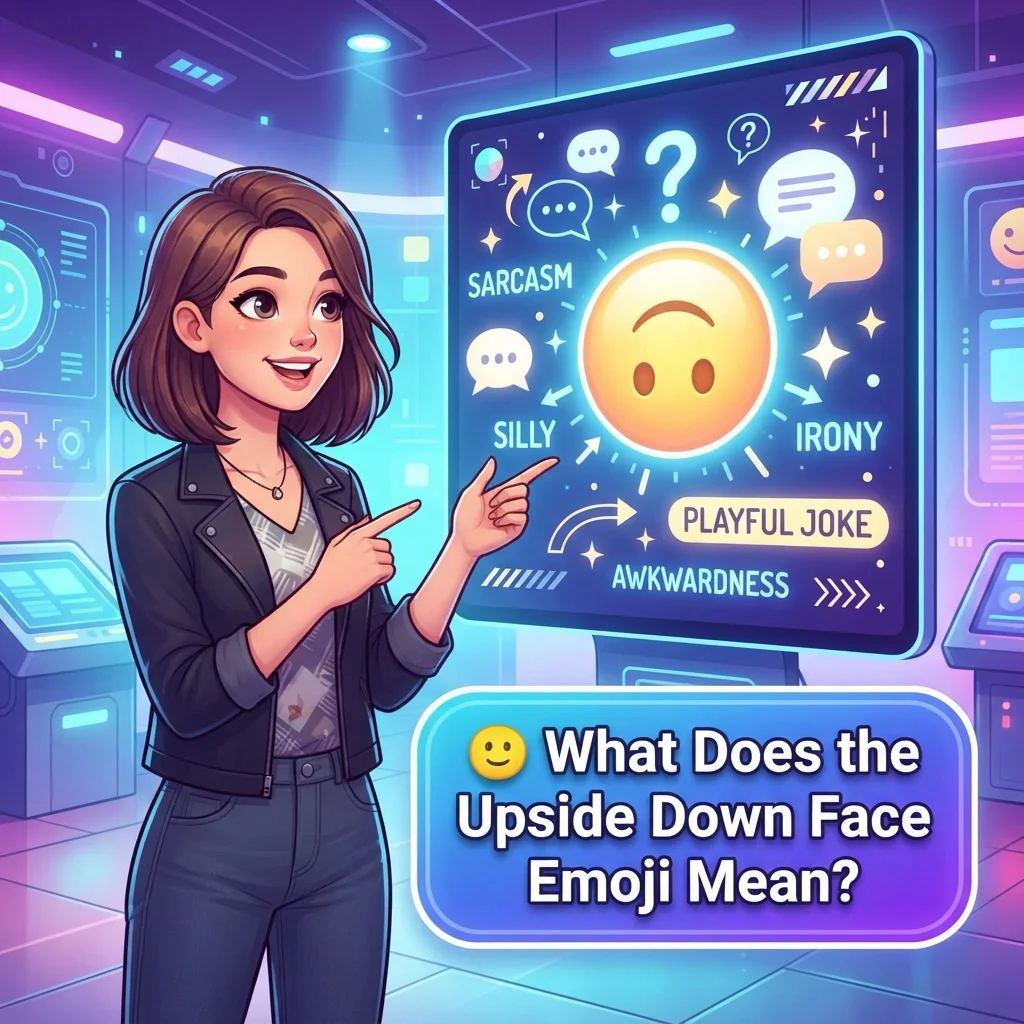
The 🙃 upside down face emoji often expresses a mixture of playfulness, awkwardness, irony, sarcasm, embarrassment, or emotional discomfort.
It can communicate a feeling that is difficult to express with ordinary words. For example, someone might say:
“I accidentally sent the message to the wrong person 🙃”
Here, 🙃 can mean something like, “Well, that was embarrassing.”
In another situation, she might write:
“Sure, I’ll do all the work again 🙃”
Now the emoji may suggest sarcasm or mild frustration.
The important point is that 🙃 often has a slightly unusual emotional tone. The words may sound normal or positive, while the emoji quietly adds another layer of meaning.
Common meanings of 🙃
When a girl sends 🙃, it may represent:
- Playfulness
- Awkwardness
- Sarcasm
- Embarrassment
- Irony
- Mild frustration
- “I’m pretending everything is fine”
- Nervous humor
- A silly or goofy mood
- Hidden annoyance
- Emotional discomfort
- An uncomfortable situation
You should look at the whole message, rather than trying to decode the emoji alone.
🙃 Upside Down Face Emoji Meaning From a Girl in Texting
In texting, a girl may use 🙃 to make a message less direct or to show that she knows something sounds strange.
For example:
Her: “I stayed awake until 4 AM watching random videos 🙃”
Here, she is probably being humorous about her poor decision.
Another example:
Her: “I totally forgot we had homework today 🙃”
This likely shows embarrassment and a joking attitude.
The emoji can also soften a statement. Instead of saying something directly, she may use 🙃 to make it sound less serious.
For example:
Her: “You could have told me earlier 🙃”
Depending on the conversation, this might mean she is slightly annoyed but not necessarily angry.
That is why the surrounding words matter so much.
🙃 What Does 🙃 Mean From a Girl to a Guy?
When a girl sends 🙃 to a guy, the meaning can vary widely. It does not automatically mean flirting or attraction.
She could be joking with him, reacting to something awkward, expressing mild annoyance, or simply using her normal texting style.
Consider this conversation:
Guy: “I forgot your birthday.”
Girl: “Wow, thanks 🙃”
The emoji probably adds sarcasm or disappointment.
Now consider:
Guy: “I think I just embarrassed myself in front of everyone.”
Girl: “Honestly, same 🙃”
Here, she is likely showing relatability and humor.
So, if you’re trying to understand the upside down face emoji meaning from a girl, don’t assume romantic interest just because she sends it to you.
🙃 Upside Down Face Emoji Meaning From a Girl to Her Crush
When a girl sends 🙃 to her crush, the emoji can sometimes appear in playful or awkward conversations.
For example:
You: “I saw you looking at me in class.”
Her: “Maybe 🙃”
This could be playful teasing. She may be avoiding giving a completely serious answer.
Another example:
You: “So you actually missed me?”
Her: “Maybe a little 🙃”
Here, the emoji can make the response feel shy, teasing, or intentionally vague.
Still, 🙃 by itself does not prove that she likes you. You should consider her overall communication. Does she start conversations? Does she keep conversations going? Does she joke with you? Does she make an effort to spend time with you?
The emoji is only one small part of the interaction.
🙃 Does 🙃 Mean She Likes You?
Not necessarily.
The upside down face emoji can appear in flirtatious conversations, but it is also extremely useful for ordinary humor and awkward situations.
For example:
“I accidentally liked his photo from 2018 🙃”
That does not necessarily communicate romantic feelings. It may simply show embarrassment.
On the other hand:
“Maybe I wanted you to notice me 🙃”
In a clearly flirtatious conversation, the same emoji could make the message feel playful and teasing.
Look for the context
If you’re wondering whether a girl likes you, pay attention to the conversation as a whole, rather than relying on 🙃.
The emoji may support a playful tone, but it cannot independently tell you what someone feels.
🙃 Meaning From a Girl in Friendship
Among friends, 🙃 often means “This situation is ridiculous” or “I can’t believe this happened.”
For example:
Friend: “I forgot my keys inside the house again.”
Girl: “You really need a new system 🙃”
Here, the emoji adds friendly teasing.
Another example:
Friend: “Our teacher gave us another assignment.”
Girl: “Of course they did 🙃”
This probably expresses shared frustration through humor.
Friends may also use 🙃 after making fun of themselves.
Girl: “I spent an hour looking for my phone while holding it 🙃”
The emoji makes the situation sound funny rather than serious.
🙃 Meaning in a Romantic Relationship
Partners can use 🙃 in many ways.
A girlfriend might send it when something mildly frustrating happens:
“You forgot to buy milk again 🙃”
Depending on her usual communication style, this could mean:
“Seriously? Again?”
It might be playful rather than genuinely angry.
She could also use it when she feels embarrassed:
“I just waved at someone who wasn’t waving at me 🙃”
Or when she wants to joke about a romantic situation:
“I guess I missed you a little 🙃”
In relationships, previous communication patterns matter. If you already know that she uses 🙃 when teasing, the meaning will be easier to understand.
🙃 Meaning From a Girl When She Is Flirting
The upside down face can sometimes create a playful and teasing tone.
For example:
You: “You looked really good today.”
Her: “You finally noticed 🙃”
This can sound teasing and confident.
Another example:
You: “Are you trying to make me jealous?”
Her: “Maybe I am 🙃”
Here, the emoji helps create a mischievous tone.
However, flirting usually comes from the words and conversation, not the emoji alone. 🙃 is not a dedicated flirting emoji.
🙃 Meaning When a Girl Is Being Sarcastic
One of the most common uses of 🙃 is sarcasm.
Suppose someone says:
“I love when my internet stops working during an important meeting 🙃”
The person probably does not literally love it.
The upside down face signals an ironic reaction. The real message is closer to:
“This is incredibly annoying, but I’m making fun of it.”
A girl might also say:
“Great, another exam tomorrow 🙃”
Again, the emoji can completely change the tone.
Without the emoji, “Great” could sound genuinely positive. With 🙃, it often signals the opposite.
🙃 Meaning When She Is Annoyed
Sometimes 🙃 shows mild annoyance or frustration.
For example:
You: “I forgot to tell you the plan changed.”
Her: “You could’ve mentioned that earlier 🙃”
She may not be furious, but she could be irritated.
Another example:
Her: “You said you’d call me yesterday 🙃”
This could carry a more serious emotional message.
In these situations, don’t focus only on the emoji. Pay attention to what she actually says.
If her message sounds genuinely upset, responding with another joke may make things worse.
🙃 Meaning When She Is Embarrassed
The upside down face is also useful when someone feels awkward or embarrassed.
For example:
“I just called my boss ‘Mom’ 🙃”
The emoji communicates the feeling of “Please let me disappear.”
A girl might send it after making a mistake, misunderstanding something, or experiencing an awkward social moment.
Example
You: “Did you actually send that screenshot to him?”
Her: “Unfortunately 🙃”
Here, she is probably embarrassed and trying to laugh about it.
🙃 Meaning in Social Media Comments
On social media, 🙃 often appears in comments, captions, replies, and memes.
A girl might comment:
“This is exactly what I needed today 🙃”
Or:
“Me making the same mistake for the fifth time 🙃”
The emoji can work especially well with relatable humor.
It may also be used after an ironic statement:
“Everything is going perfectly 🙃”
If the situation obviously isn’t going perfectly, the emoji tells readers that the statement is sarcastic.
🙃 Meaning in Snapchat
On Snapchat, emoji meanings can be especially dependent on the conversation.
If a girl sends a photo of herself making a funny expression with 🙃, she may simply be being goofy.
If she sends:
“Guess who forgot their charger 🙃”
she is probably joking about an annoying situation.
If she sends it after a teasing message, it may carry a playful tone.
The best approach is to consider what happened immediately before she sent it.
🙃 Meaning on Instagram
On Instagram, 🙃 can appear in captions, comments, DMs, and replies.
A caption such as:
“Another productive day of doing absolutely nothing 🙃”
uses the emoji for irony.
A comment such as:
“You really did that 🙃”
could be teasing, amused, surprised, or slightly critical depending on the situation.
Again, there is no universal translation for 🙃.
🙃 Meaning in Different Situations
| Situation | Possible meaning |
| Funny mistake | “Well, that happened.” |
| Awkward moment | “This is embarrassing.” |
| Sarcastic statement | “I don’t actually mean this literally.” |
| Mild annoyance | “Seriously?” |
| Flirty conversation | Playful teasing |
| Friendship | Friendly humor |
| Relationship | Teasing, awkwardness, or mild frustration |
| Social media | Irony or relatable humor |
| Bad situation | “I’m trying to laugh about it.” |
These are possible interpretations, not fixed rules.
🙃 Friendly vs. Romantic Meaning
It can be tempting to interpret every emoji from a girl romantically, especially if you have a crush on her. But 🙃 is commonly used in ordinary conversations too.
Friendly 🙃
A friendly use might look like:
“We both forgot the meeting 🙃”
The girl is probably sharing the joke with you.
Romantic or flirty 🙃
A potentially flirty use might look like:
“You really know how to make me smile 🙃”
Here, the romantic tone comes mainly from the words and situation.
The emoji simply adds a playful layer.
The key difference is context, not the emoji itself.
🙃 Positive Meaning
Although 🙃 can sometimes indicate frustration, it is often used positively in a playful way.
A girl might use it when she is:
- Laughing at herself
- Teasing you
- Making a silly joke
- Sharing an embarrassing story
- Being playful
- Acting goofy
- Making an ironic comment
For example:
“I ordered food and forgot to order drinks 🙃”
She may simply be laughing at her own mistake.
🙃 Negative or Uncomfortable Meaning
The emoji can also communicate something less positive.
It may suggest:
- Mild irritation
- Awkwardness
- Disappointment
- Sarcasm
- Emotional discomfort
- “I’m pretending this is okay”
- Passive frustration
For example:
“You didn’t tell me you were bringing everyone 🙃”
Depending on the relationship, she may feel uncomfortable or annoyed.
This is why it can be risky to automatically treat 🙃 as a cute or positive emoji.
🙃 vs. 🙂 — What’s the Difference?
The difference between 🙂 and 🙃 can be surprisingly important.
🙂 Slightly Smiling Face generally feels more straightforward and normal. It can communicate friendliness, politeness, warmth, or a simple smile.
🙃 Upside Down Face adds something unusual to the message. It can suggest irony, awkwardness, silliness, sarcasm, or “I’m not taking this completely seriously.”
Compare:
“Sure 🙂”
with:
“Sure 🙃”
The first can sound straightforward.
The second may sound like there is something behind the word “sure.”
That “something” could be humor, annoyance, awkwardness, or sarcasm.
🙃 vs. 😅 — What’s the Difference?
😅 usually communicates nervous laughter, embarrassment, relief, or awkward humor.
🙃 can communicate similar awkwardness, but it often has a stronger sense of irony or absurdity.
For example:
“I forgot my assignment 😅”
This sounds like nervous embarrassment.
“I forgot my assignment 🙃”
This can sound more like, “Of course I forgot it. What a mess.”
The distinction is subtle, and people use emojis differently.
🙃 vs. 😏 — What’s the Difference?
😏 often has a more obvious smirking, confident, teasing, or suggestive tone.
🙃 is generally more awkward, ironic, silly, or sarcastic.
So if a girl sends 🙃, don’t automatically interpret it as the same kind of flirtation associated with 😏.
🙃 vs. 😬 — What’s the Difference?
😬 commonly represents awkwardness, nervousness, tension, or discomfort.
🙃 can also show discomfort, but it often adds humor or irony.
For example:
“That conversation was awkward 😬”
sounds directly uncomfortable.
“That conversation was awkward 🙃”
can sound like the person is laughing at how strange the situation was.
Why Does a Girl Use 🙃 Instead of Words?
Emojis help people communicate emotional tone quickly.
Text messages don’t contain facial expressions, voice tone, or body language. A short sentence can therefore be misunderstood.
Consider:
“Nice.”
Depending on the situation, this could be sincere, annoyed, sarcastic, or indifferent.
Adding an emoji gives the reader an extra clue.
When a girl uses 🙃, she may be signaling:
“Don’t read this completely literally.”
Or:
“This situation is weird, but I’m laughing about it.”
Or:
“I’m slightly annoyed, but I’m not trying to make this a huge argument.”
How to Respond When a Girl Sends 🙃
Your response should depend on what she said.
If she’s clearly joking, joke back.
Her: “I forgot my own password again 🙃”
You: “At this point, your password is your biggest enemy 😂”
If she seems embarrassed, reassure her.
Her: “I waved at someone who wasn’t waving at me 🙃”
You: “Don’t worry, we’ve all done that.”
If she sounds annoyed, don’t ignore the underlying message.
Her: “You could’ve told me earlier 🙃”
A better response might be:
“You’re right. I should’ve told you sooner. Sorry.”
If she’s your friend
Keep it casual:
“Classic 😂”
or:
“How do you keep doing this? 😂”
If she’s your crush
You can respond playfully without assuming anything:
“That sounds suspiciously like a confession 🙃”
Or simply:
“Okay, now I need the full story 😂”
If she’s your partner
If the message sounds frustrated, take the words seriously:
“I get why you’re annoyed. I’ll make sure I tell you next time.”
A playful emoji doesn’t always mean the underlying issue is a joke.
Common Misunderstandings About 🙃
“🙃 Always means flirting”
No. A girl can use 🙃 with friends, family, classmates, coworkers, or anyone else.
“🙃 Means she is angry”
Not necessarily. It can indicate mild frustration, but it is also frequently playful or humorous.
“🙃 Means she is hiding her feelings”
Sometimes a person may use humor to soften an emotional statement, but you cannot know this from the emoji alone.
“If she sends 🙃, she definitely likes me”
There isn’t enough information to make that conclusion.
Look at the broader conversation and the person’s behavior instead.
“The emoji has only one meaning”
Emoji communication is flexible. People develop their own texting habits, and meanings can change from one conversation to another.
When Should You Take 🙃 Seriously?
Pay more attention when the emoji appears alongside a clear complaint.
For example:
“You canceled again 🙃”
The emoji might soften the message, but the cancellation is still the important part.
Similarly:
“I waited for you for an hour 🙃”
The underlying statement suggests frustration or disappointment.
In these situations, don’t respond only to the emoji. Respond to the actual concern.
How Context Changes the Meaning of 🙃
The same emoji can mean very different things in different conversations.
Imagine a girl sends:
“I finally finished my homework 🙃”
After studying all night, this might mean she is exhausted but amused.
Now imagine:
“You forgot again 🙃”
This could be mild frustration.
And:
“Maybe I like you a little 🙃”
This could sound playful or flirtatious.
The emoji didn’t change. The context did.
That is one of the most important things to remember when interpreting emojis.
What Does 🙃 Mean at the End of a Sentence?
When 🙃 appears at the end of a sentence, it often modifies the emotional tone of everything that came before it.
For example:
“I guess I’ll do it myself 🙃”
The emoji can make the sentence sound sarcastic or mildly annoyed.
“I just embarrassed myself in front of everyone 🙃”
Here it suggests awkward humor.
“Sure, that sounds like a great idea 🙃”
This may indicate irony rather than genuine enthusiasm.
So, when you see 🙃 at the end of a sentence, read the complete message first.
What Does 🙃 Mean When She Sends It Alone?
If a girl sends only:
🙃
the interpretation becomes more difficult.
It might mean:
- “What can I even say?”
- “This is awkward.”
- “I’m joking.”
- “Seriously?”
- “Well, that happened.”
- “I’m embarrassed.”
- “I’m pretending everything is fine.”
- “You are ridiculous.”
- “I’m being silly.”
You need more context to determine which one fits.
If the conversation has suddenly become confusing, a simple response such as “Haha, what does that mean? 😂” can invite clarification without making the situation awkward.
When a Girl Sends 🙃 After a Compliment
This can have several interpretations.
You: “You look amazing today.”
Her: “Stop 🙃”
She might be embarrassed, teasing, or playfully accepting the compliment.
Another example:
You: “You’re actually really funny.”
Her: “I know 🙃”
That can sound confident and playful.
The surrounding conversation helps distinguish genuine confidence from teasing.
When a Girl Sends 🙃 After an Apology
Suppose you say:
You: “Sorry I forgot to reply.”
Her: “It’s okay 🙃”
This could genuinely mean she accepts your apology. But it could also suggest she is not completely happy about what happened.
If you know she normally uses 🙃 in sarcastic situations, you may want to check the tone rather than assuming everything is fine.
A thoughtful response could be:
“Are you actually okay with it? I don’t want to brush it off.”
That gives her room to explain.
When a Girl Uses 🙃 Repeatedly
If someone regularly uses 🙃, it may simply be part of her personal texting style.
Some people use the same emoji frequently because it matches their personality or sense of humor.
If she sends 🙃 after almost every joke, mistake, or awkward situation, you shouldn’t assign a completely different meaning every time.
Her personal emoji habits matter.
A Simple Way to Understand 🙃
When you’re unsure what a girl means by 🙃, ask yourself three questions:
What did she say?
Look at the actual words first.
What happened before the message?
The situation often reveals whether she’s joking, annoyed, embarrassed, or flirting.
How does she normally text?
Her usual emoji habits can provide important clues.
This approach is much more reliable than treating 🙃 like a secret code.
Quick Guide to the Upside Down Face Emoji Meaning From a Girl
| Her message | Likely tone |
| “I forgot again 🙃” | Self-deprecating humor |
| “Great, another test 🙃” | Sarcasm/frustration |
| “Maybe I like you 🙃” | Playful or teasing |
| “You could’ve told me 🙃” | Mild annoyance |
| “I waved at a stranger 🙃” | Embarrassment |
| “Of course this happened 🙃” | Irony |
| “I guess I’ll do it myself 🙃” | Possible frustration |
| “Stop making me blush 🙃” | Playful/embarrassed |
These examples show why the emoji needs to be interpreted alongside the message.
Final Thoughts
The upside down face emoji meaning from a girl can range from playful humor to sarcasm, awkwardness, embarrassment, mild frustration, or teasing. It is one of those emojis whose meaning depends heavily on the situation rather than having one simple definition.
If she sends 🙃 after a silly mistake, she may be laughing at herself. If she uses it after a complaint, it could signal mild annoyance. In a playful conversation with a crush, it may add a teasing or slightly flirty tone.
Frequently Asked Questions
What does 🙃 mean from a girl?
From a girl, 🙃 can mean playfulness, sarcasm, awkwardness, embarrassment, irony, or mild frustration. The exact meaning depends on the words and situation surrounding the emoji.
Does 🙃 mean a girl likes you?
Not necessarily. A girl may use 🙃 when flirting, but she can also use it with friends or in ordinary conversations. The emoji alone isn’t enough to determine romantic interest.
What does 🙃 mean from a girl to a guy?
It can mean she is joking, teasing, feeling awkward, being sarcastic, or mildly annoyed. In a clearly flirtatious conversation, it can add a playful tone, but context matters.
Is 🙃 a flirting emoji?
🙃 can appear in flirting, especially when someone is teasing or being playful. However, it is not specifically a flirting emoji, and many people use it for humor, irony, and awkward situations.
What does 🙃 mean in texting?
In texting, 🙃 commonly communicates irony, awkward humor, sarcasm, embarrassment, silliness, or mild frustration. It can also soften a message that might otherwise sound too serious.
What does 🙃 mean when a girl sends it alone?
A standalone 🙃 is difficult to interpret without context. It might mean “this is awkward,” “seriously?”, “what can I say?”, “I’m joking,” or “well, that happened.”
What is the difference between 🙃 and 🙂?
🙂 usually feels more straightforward and friendly, while 🙃 often adds irony, awkwardness, sarcasm, or playful discomfort. The upside-down orientation gives the message a less literal feeling.
How should I reply when a girl sends 🙃?
Read the message first. If she’s joking, you can joke back. If she seems embarrassed, reassure her. If she sounds annoyed, address what she actually said instead of focusing only on the emoji.

I am Grace Wilson, a passionate writer dedicated to creating helpful, engaging, and informative content for readers around the world. I am committed to sharing well-researched ideas, practical knowledge, and meaningful stories that inspire and educate. With a focus on clarity and authenticity, I am always exploring new topics and bringing valuable insights to my audience.