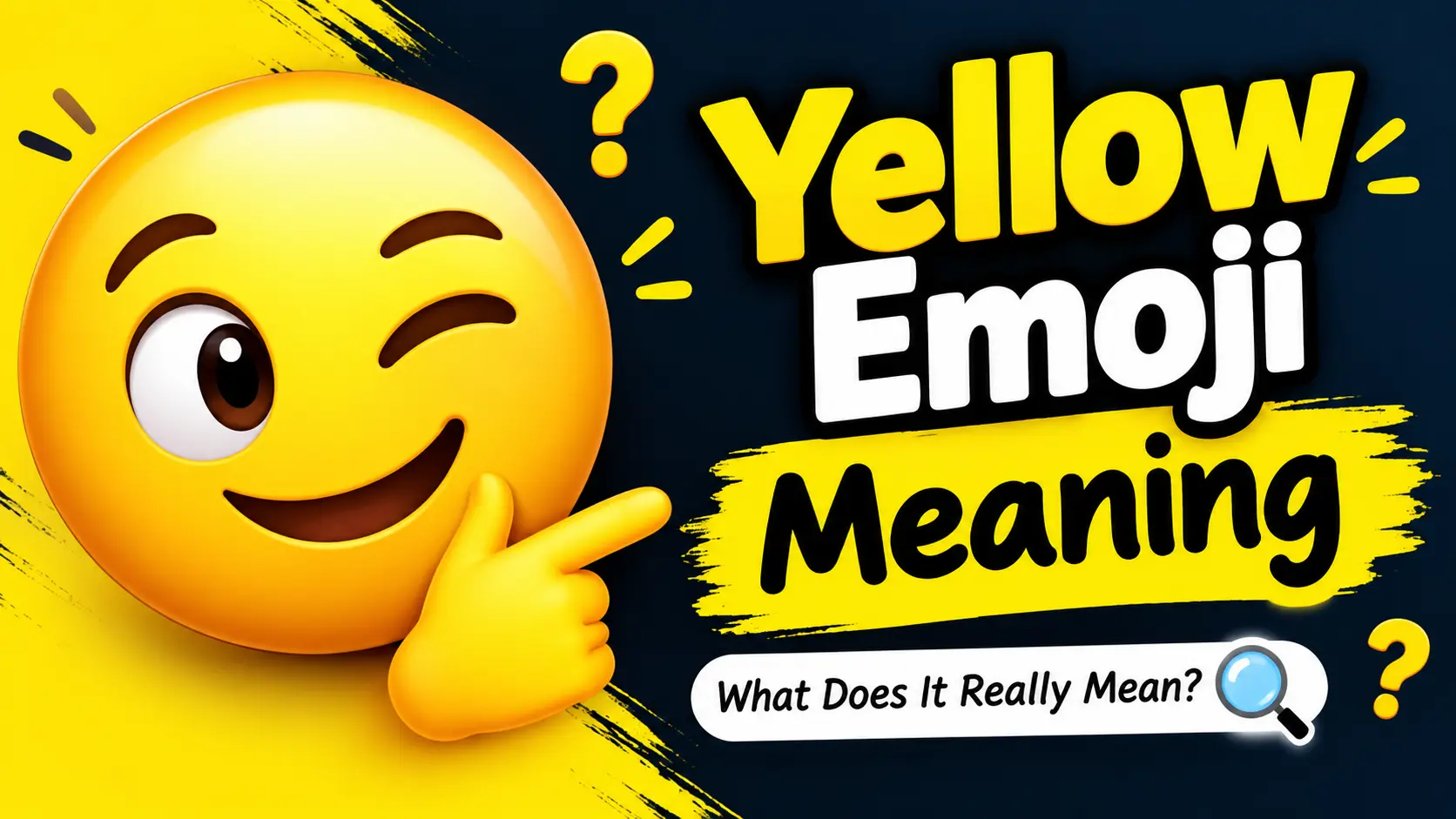
Bright colors often make a message feel warmer, happier, and more positive. 💛 Yellow emojis are especially common in casual conversations because they can express friendship, happiness, kindness, support, affection, and positive energy. Still, the exact Yellow Emoji Meaning can change depending on the emoji and the context.
A yellow heart 💛 may show friendship or caring feelings, while a smiling yellow face can communicate happiness or friendliness. Other yellow emojis can add humor, excitement, encouragement, or a playful mood to a conversation.
In this guide, we’ll explain the Yellow Emoji Meaning in simple terms. You’ll learn what popular yellow emojis mean in texting and social media, how their meanings can change between friends and romantic conversations, and what someone may be trying to express when they send one.
What Does the Yellow Emoji Mean? 💛
In general, yellow emojis are associated with happiness, positivity, friendship, warmth, joy, and affection. Yellow is visually bright, so people often use yellow emojis when they want their message to feel cheerful or welcoming.
Still, the meaning depends heavily on the specific emoji. A yellow heart may carry an emotional message, while a yellow face may simply react to something funny or pleasant.
Here are some common ideas connected with yellow emojis:
| Meaning | What it can express |
| Happiness | Feeling cheerful or excited |
| Friendship | Showing friendly affection |
| Warmth | Making a message feel kind and welcoming |
| Positivity | Sharing an optimistic mood |
| Care | Showing that someone matters |
| Playfulness | Making a conversation less serious |
| Affection | Expressing fondness without necessarily being romantic |
| Support | Encouraging someone or showing emotional support |
The important point is that emoji meaning is contextual. The same emoji can feel different when sent by a close friend, partner, family member, stranger, or crush.
Yellow Emoji Meaning in Text Messages 💬
In text messages, a yellow emoji can add emotion to words that might otherwise seem plain. Text has no facial expression or voice, so people often use emojis to make their intended tone clearer.
For example:
“Good luck today 💛”
Here, the yellow heart can make the message feel supportive and caring.
Another example is:
“That was so funny 😂💛”
In this case, the yellow heart adds warmth or affection to an already playful message.
Someone might also write:
“Thank you so much ☀️”
The sunshine emoji can make the response sound cheerful and positive.
Therefore, when someone sends you a yellow emoji, don’t look only at the symbol. Read the complete message and think about what was happening before it.
Yellow Emoji Meaning on Social Media 📱
Yellow emojis appear frequently in social media captions, comments, stories, and direct messages.
People often use them to make posts look brighter and more positive. A yellow heart can appear in friendship posts, appreciation messages, birthday captions, or supportive comments.
For example:
“So proud of you 💛”
This usually communicates warmth and support.
A person might comment:
“You absolutely nailed it! 💛”
Here, the yellow heart strengthens the positive feeling.
Yellow emojis can also work as visual decoration. In a caption, someone may use several yellow symbols simply because they match the mood, clothing, photographs, or overall colour scheme of the post.
That means an emoji does not always contain a deep hidden message.
Yellow Emoji Meaning in Friendship 🤝
Among friends, yellow emojis often communicate friendly love, loyalty, appreciation, encouragement, and emotional closeness.
The yellow heart 💛 is especially common when someone wants to show that they care about a friend without automatically making the message sound romantic.
For example:
Friend: “You always know how to make me laugh 💛”
This sounds affectionate, but the context points toward friendship.
Another example:
“Thanks for being there for me 💛”
The emoji can reinforce gratitude and emotional support.
Close friends may also use yellow emojis casually without analysing their meaning at all. Sometimes an emoji simply becomes part of the way two people normally text each other.
Yellow Emoji Meaning in Romantic Relationships ❤️
A yellow emoji can also appear in romantic conversations, but its meaning may differ from a traditional red heart ❤️.
The red heart is widely associated with romantic love and strong affection. A yellow heart 💛 can feel softer, warmer, more playful, or more friendship-oriented.
For example:
“Good morning, beautiful 💛”
From a romantic partner, the yellow heart may simply be their personal way of showing affection.
Likewise:
“I had such a good time with you tonight 💛”
The emoji adds tenderness to the message.
However, you should not assume that a yellow heart means someone has romantic feelings. Emoji colours do not provide a reliable way to determine someone’s intentions by themselves.
Yellow Emoji Meaning From a Girl 👩
When a girl sends a yellow emoji, the meaning depends on your relationship and the conversation.
If she sends:
“Thank you for helping me 💛”
she may simply be expressing appreciation.
If she sends:
“You’re the sweetest 💛”
the emoji can make the message feel affectionate and warm.
If you’re already dating, it may simply be a normal expression of affection.
If you’re wondering whether she likes you romantically, look at the overall communication pattern, not one emoji. Her words, behaviour, consistency, and the broader context provide much more information than the colour of a heart.
Yellow Emoji Meaning From a Guy 👨
A guy may use a yellow emoji to show friendliness, appreciation, support, or affection.
For example:
“Good luck with your exam 💛”
This sounds supportive.
He might also say:
“You’re awesome 💛”
Depending on your relationship, that could be friendly, affectionate, or simply encouraging.
Some people use yellow emojis because they like the colour or because it is part of their normal texting style. Therefore, receiving a yellow emoji from a guy does not automatically indicate romantic interest.
Yellow Emoji Meaning From a Crush 😍
A yellow emoji from a crush can feel more meaningful because you already have feelings for that person. However, it still does not provide definite evidence of romantic interest.
Suppose your crush says:
“Hope your day goes well 💛”
That could be sweet and affectionate. It could also be a friendly gesture.
Now consider:
“I really enjoyed spending time with you today 💛”
The surrounding message carries more emotional information than the emoji itself.
If you are trying to understand a crush’s intentions, focus on the conversation as a whole. One emoji rarely gives you enough information to draw a definite conclusion.
Yellow Emoji Meaning From a Partner 💛
Partners may use yellow emojis to communicate affection, reassurance, encouragement, or happiness.
For example:
“I’m proud of you 💛”
The yellow heart can add tenderness.
A partner might also use a yellow smiley after a playful comment:
“You really thought you could beat me at that game? 😄💛”
Here, the emoji combination creates a lighthearted tone.
The colour does not necessarily indicate a particular level of love. Couples often develop their own emoji habits, and those personal habits can matter more than general emoji interpretations.
Friendly Meaning of Yellow Emojis 😊
Yellow emojis are strongly associated with friendly communication.
They can make a message sound less cold or formal. Compare:
“Thanks.”
with:
“Thanks 💛”
The second version generally feels warmer.
Similarly:
“Take care.”
can become:
“Take care ☀️”
The sunshine symbol can give the message a brighter, more cheerful feeling.
This is one reason yellow emojis are popular in everyday conversations.
Romantic Meaning of Yellow Emojis 💛
Yellow emojis can have romantic meanings, especially when they appear alongside affectionate language.
For example:
“Miss you already 💛”
or:
“Can’t wait to see you tonight 💛”
In these examples, the words establish the romantic context. The yellow emoji reinforces the feeling.
However, yellow does not automatically mean romance. The same 💛 can appear between siblings, friends, classmates, or family members.
Emotional Meaning of Yellow Emojis
Yellow emojis can communicate several emotions at once.
They may express:
- happiness
- gratitude
- affection
- comfort
- encouragement
- excitement
- friendliness
- optimism
- appreciation
For example, someone going through a difficult day might receive:
“You’ll get through this 💛”
The yellow heart can make the message feel gentle and supportive.
Likewise:
“I’m really happy for you! ☀️”
uses the sunshine emoji to strengthen the positive emotion.
Playful Meaning of Yellow Emojis 😄
Yellow faces are often used playfully.
A smiling yellow face can make a statement sound lighter and less serious. For example:
“You owe me ice cream 😄”
The emoji can signal that the sender is joking rather than making a serious demand.
Yellow emojis can also soften teasing:
“You really forgot again? 😂💛”
The combination suggests humour and warmth.
This is why context matters so much. Without the emoji, a sentence may sound annoyed. With it, the sender may be signalling that they are teasing.
Sarcastic or Humorous Yellow Emoji Meaning
Yellow emojis can sometimes accompany sarcasm.
For example:
“Great, another Monday 😃”
The smiling face might be sincere, but depending on the situation, it could be sarcastic.
Likewise:
“Wonderful. My internet stopped working again 🙂”
The smile may contrast with the negative situation, creating humour or irony.
You need to consider the words, timing, and relationship before deciding whether an emoji is sincere or sarcastic.
Positive Yellow Emoji Meaning
Most yellow emojis have positive or neutral associations.
A sender may use one when they want to:
- celebrate good news
- congratulate someone
- show appreciation
- cheer someone up
- express happiness
- make a message friendlier
- show support
For example:
“You passed! 🎉💛”
Here, the yellow heart complements the celebration.
Or:
“Thank you for always supporting me 💛”
The emoji adds emotional warmth.
Can a Yellow Emoji Have a Negative Meaning? 🤔
Yes, depending on context.
The emoji itself may not be negative, but people can use positive-looking emojis sarcastically, ironically, or passively aggressively.
For example:
“Sure, I’ll do everything myself 🙂”
The smiling emoji might not represent genuine happiness.
Likewise:
“That’s exactly what I wanted 💛”
could be sincere or sarcastic depending on what happened.
This is why searching for a fixed emoji definition cannot always explain a real conversation. Human communication is more flexible than dictionary-style meanings.
Yellow Heart 💛 vs Red Heart ❤️
The yellow heart and red heart can overlap, but people often perceive them differently.
| Emoji | Common association |
| 💛 | Friendship, warmth, care, happiness |
| ❤️ | Love, romance, deep affection |
| 🧡 | Warmth, affection, enthusiasm |
| 💚 | Support, nature, growth, various personal meanings |
| 💙 | Trust, loyalty, calm affection |
| 💜 | Affection, support, creativity, various meanings |
| 🤍 | Gentle affection, peace, sincerity |
| 🖤 | Dark humour, style, grief, or affection depending on context |
These are common associations rather than strict rules.
For example, a couple may regularly use 💛 instead of ❤️ because they simply prefer it. Likewise, friends can use ❤️ without intending romance.
Yellow Heart 💛 vs Smiling Face 😊
These two emojis communicate different things.
The yellow heart usually focuses more on affection, care, friendship, or emotional warmth.
The smiling face focuses more on happiness, friendliness, or a positive reaction.
Compare:
“Thanks for helping me 💛”
This feels appreciative and affectionate.
“Thanks for helping me 😊”
This feels happy and friendly.
The difference is subtle, but it can affect the tone of the message.
Yellow Heart 💛 vs Sunshine ☀️
Both can create a positive feeling, but they work differently.
The yellow heart usually relates to a person or emotional connection.
The sunshine emoji often represents brightness, happiness, optimism, warmth, or a beautiful day.
For example:
“I’m always here for you 💛”
focuses on emotional support.
“Have a beautiful day ☀️”
focuses more on positivity and good wishes.
Yellow Emoji Meaning in Different Situations
The same yellow emoji can communicate different ideas in different settings.
| Situation | Possible meaning |
| Friend sends 💛 | Friendship or appreciation |
| Partner sends 💛 | Affection or tenderness |
| Crush sends 💛 | Warmth or possible affection, but not proof of romance |
| Family member sends 💛 | Love and care |
| Coworker sends 💛 | Appreciation or friendly support |
| Social media comment 💛 | Positive reaction or encouragement |
| Birthday message 💛 | Celebration and affection |
| Supportive message 💛 | Comfort and care |
| Joke with 💛 | Playfulness and warmth |
Notice the phrase possible meaning. That’s important because emoji interpretation is not universal.
What Does a Yellow Emoji Mean From Your Crush?
If your crush sends a yellow emoji, don’t immediately assume they are flirting.
Look at the surrounding conversation.
For example:
“You looked great today 💛”
could feel more personal than:
“Thanks for the notes 💛”
The first message contains a personal compliment. The second may simply express gratitude.
Also consider whether your crush uses the same emoji with everyone. If they frequently send 💛 to friends, the symbol may be part of their normal communication style.
What Does a Yellow Emoji Mean From Your Partner?
From a partner, a yellow emoji often communicates warmth and affection.
It might appear after:
“I’m proud of you.”
“I miss you.”
“Sleep well.”
“You made my day.”
The exact meaning comes from the entire message. A partner may also choose yellow because they associate it with happiness, sunshine, or a particular personal memory.
What Does a Yellow Emoji Mean From a Friend?
From a friend, yellow emojis commonly communicate:
“I care about you.”
“I’m happy for you.”
“Thanks.”
“I’m supporting you.”
“You’re important to me.”
For example:
Friend: “I finally got the job!”
You: “That’s amazing! So happy for you 💛”
The yellow heart adds warmth without changing the basic message.
What Does a Yellow Emoji Mean From Family?
Family members may use yellow emojis to express love, care, congratulations, or encouragement.
A parent might write:
“Good luck at school today 💛”
A sibling might write:
“Happy birthday! 💛🎉”
A relative could comment:
“So proud of you 💛”
In these situations, the emoji usually supports an existing family relationship rather than signalling romance.
How to Respond to a Yellow Emoji
Your response should match the tone of the conversation.
If a friend sends:
“Thanks for everything 💛”
you could respond:
“Always! 😊”
If a crush sends:
“Hope you have a great day 💛”
you could reply:
“Thank you! I hope yours is great too 😊”
If your partner sends:
“Miss you 💛”
a natural response could be:
“Miss you too ❤️”
You don’t have to copy the exact emoji. Your words matter more.
If You Want to Keep It Friendly
Try:
“Aww, thank you! 💛”
or:
“You too! 😊”
If You Want to Sound Affectionate
Try:
“That means a lot to me 💛”
or:
“You’re so sweet ❤️”
If You Want to Flirt
If the existing conversation is already romantic, you could say:
“You know how to make me smile 😏”
The key is to respond naturally rather than trying to decode every emoji as a hidden message.
Common Situations Where Yellow Emojis Appear
Yellow emojis work well in many everyday situations.
Good Morning Messages
“Good morning! Hope you have a lovely day ☀️💛”
The emojis create a cheerful and caring tone.
Congratulations
“You did it! 🎉💛”
The yellow heart adds warmth to the celebration.
Thank-You Messages
“Thanks for always helping me 💛”
This communicates appreciation.
Encouragement
“You’ve got this! 💛”
The emoji makes the encouragement feel more personal.
Friendship Posts
“Best friends forever 💛”
The yellow heart can highlight friendship and emotional closeness.
Birthday Posts
“Happy birthday to one of my favourite people! 🎂💛”
The yellow heart adds affection.
Casual Conversations
“See you tomorrow 💛”
Depending on the relationship, this can simply feel warm and friendly.
Common Misunderstandings About Yellow Emojis
One common mistake is assuming that every emoji has one fixed meaning.
It doesn’t.
People use emojis differently based on age, culture, personality, platform, friendship groups, and personal habits.
Another misconception is that the colour of a heart always reveals romantic feelings. It doesn’t. A yellow heart can be romantic in one conversation and completely platonic in another.
Some people also believe that changing from a red heart to a yellow heart always signals a change in feelings. That’s not necessarily true. The sender may simply prefer yellow.
Context Matters More Than the Colour
Consider these two messages:
“Thanks for the birthday gift 💛”
and
“I love spending time with you 💛”
Both contain the same yellow heart, but the surrounding words create different emotional contexts.
The emoji supports the message rather than replacing it.
Why Do People Use Yellow Emojis So Often?
Yellow is visually bright and commonly associated with cheerful feelings. As a result, yellow emojis can make digital conversations feel more lively.
They are also useful because they can express affection without always sounding intensely romantic.
For example, someone might hesitate to send ❤️ to a new friend because it could be interpreted romantically. 💛 can offer a softer alternative.
Still, personal preferences vary. Some people use ❤️, 💛, 🩷, 😊, or ☀️ almost interchangeably in casual conversations.
Does a Yellow Emoji Mean Someone Likes You?
Not necessarily.
A yellow emoji can indicate that someone likes you, cares about you, appreciates you, or feels comfortable with you. But it cannot prove romantic interest.
If someone sends:
“You’re such a good friend 💛”
the word friend gives you important context.
If someone sends:
“I love talking to you every night 💛”
the message is more personal, but even then, the emoji alone does not establish romantic intent.
Look at the complete pattern of communication rather than treating one symbol as a secret code.
Are Yellow Emojis Flirty?
They can be used in flirting, but they are not inherently flirty.
For example:
“You looked really good today 💛”
may feel flirtatious depending on who sent it and why.
On the other hand:
“Thanks for the help 💛”
is normally just appreciative.
Words, relationship, timing, and conversation history all influence the interpretation.
Yellow Emoji Meaning in Gen Z Conversations
Younger users often use emojis in flexible and sometimes ironic ways. An emoji may not always represent its literal emotional meaning.
A smiling face can be used sarcastically. A heart can be added simply for aesthetic reasons. Multiple emojis may also create a particular social-media style.
Because online communication changes quickly, there is no universal rule saying that every yellow emoji has one Gen Z meaning.
The safest approach is to interpret the emoji alongside the actual message and the sender’s normal texting style.
Cultural and Personal Differences in Emoji Meaning
Emoji interpretation can vary between cultures and communities.
A symbol that feels affectionate to one person may feel casual to another. Age can also influence emoji habits. Some people use emojis heavily, while others rarely use them.
Personal communication style matters too.
If someone sends 💛 to almost everyone, you should probably interpret it differently from someone who rarely uses heart emojis and sends one specifically to you.
This is why yellow emoji meaning should be understood as a range of common interpretations rather than one universal definition.
A Simple Way to Understand Any Yellow Emoji
When you’re unsure what someone means, ask yourself these five questions:
- Which yellow emoji did they send?
- What did they say with it?
- What is your relationship with them?
- Do they normally use this emoji?
- Does the overall conversation feel friendly, romantic, funny, or serious?
These questions can help you understand the intended tone much better than looking at the emoji alone.
Final Thoughts 💛
The yellow emoji meaning generally revolves around happiness, warmth, friendship, care, positivity, and affection, but the exact interpretation depends on the emoji and the situation.
A yellow heart 💛 can show friendship or emotional warmth. A yellow smiling face can communicate happiness or friendliness. A sunshine emoji ☀️ can suggest optimism, brightness, or good wishes.
Frequently Asked Questions
What is the general yellow emoji meaning?
The general yellow emoji meaning is usually connected with happiness, positivity, friendship, warmth, care, and affection. The exact meaning depends on the specific emoji and the conversation.
What does the yellow heart 💛 mean in texting?
The yellow heart 💛 often represents friendship, care, appreciation, emotional warmth, or gentle affection. It can also appear in romantic conversations, so context matters.
Does a yellow heart 💛 mean love?
It can express love or affection, but it does not automatically mean romantic love. Friends, family members, and partners can all use the yellow heart.
Is a yellow heart 💛 flirty?
A yellow heart can be flirty in some conversations, but it is not inherently a flirting emoji. The surrounding words and relationship are more important than the emoji colour.
What does a yellow emoji mean from a girl?
A yellow emoji from a girl can mean friendliness, appreciation, support, affection, or playfulness. It does not automatically indicate romantic interest.
What does a yellow emoji mean from a guy?
A guy may use a yellow emoji to show friendship, encouragement, appreciation, warmth, or affection. The exact meaning depends on his communication style and the context.
What is the difference between 💛 and ❤️?
💛 is commonly associated with friendship, warmth, happiness, and gentle affection, while ❤️ is more strongly associated with love and romantic affection. However, people use both differently.
How should I respond when someone sends a yellow emoji?
Match the tone of the conversation. You can reply with words, an emoji, or both. For example, a friendly “Thank you! 💛” works for casual situations, while a romantic conversation may call for a more affectionate response.

I am Grace Wilson, a passionate writer dedicated to creating helpful, engaging, and informative content for readers around the world. I am committed to sharing well-researched ideas, practical knowledge, and meaningful stories that inspire and educate. With a focus on clarity and authenticity, I am always exploring new topics and bringing valuable insights to my audience.