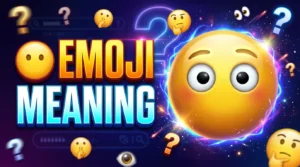
Have you ever received a message with the 🫣 emoji and wondered, “What does that actually mean?” The 🫣 emoji, officially known as the Face with Peeking Eye, is one of those expressive emojis that can say a lot without using any words.
It usually represents shyness, embarrassment, awkwardness, nervousness, curiosity, or wanting to look at something while pretending not to. Depending on the conversation, someone might use 🫣 when they feel shy about a compliment, are embarrassed by something they said, or are secretly curious about what is happening.
It can also add a playful or teasing tone to a text, especially when someone is interested in another person.
Spiritual Meaning
Some people who explore symbols and energy see the peeking eye as a sign of cautious awareness. It can suggest that part of you wants to stay protected while another part remains open to truth or new information.
In certain mindfulness and intuition-focused practices, this image is linked to selective attention, choosing what to fully face and what to observe from a safer distance. Many believe it reflects a period of gentle awakening where you are noticing things you previously avoided.
These spiritual readings are personal and not universal. They simply offer one way some people make sense of the mixed feelings the emoji expresses.
Biblical Meaning
There is no direct biblical reference to a face peeking through fingers. Scripture does not mention this specific image.
Some readers loosely connect the idea of covering the eyes or looking carefully to themes of caution, humility, or discernment found in various passages about wisdom and careful speech. However, forcing a strong biblical link would be inaccurate. The emoji is a modern digital symbol, not an ancient religious one.
If the image appears in a dream alongside religious themes, personal faith and context matter far more than any fixed interpretation.
Psychological Meaning
From a modern psychology view, the 🫣 emoji mirrors common internal conflicts. It often appears when someone feels social anxiety, performance pressure, or second-hand embarrassment. The covered face suggests a desire to hide, while the open eye shows the brain’s strong pull toward information or social feedback.
It can also reflect curiosity mixed with mild fear, exactly the state many people experience when watching suspenseful content, reading awkward messages, or navigating uncertain relationships. Stress, recent memories, and relationship dynamics frequently color how and when people reach for this emoji.
Psychologists note that digital symbols like this help people express complex feelings quickly when words feel too heavy or too revealing.
Emotional Meaning
This emoji commonly reflects:
- Shyness or bashfulness
- Nervous anticipation
- Mild shame or “cringe”
- Guilty pleasure curiosity
- Soft hesitation in flirting or teasing
- The feeling of being both drawn in and slightly overwhelmed
It rarely signals pure joy or pure fear. Instead, it sits in the middle zone where emotions overlap.
Positive Meanings
Many people use 🫣 in light, friendly, or even warm ways:
- Playful curiosity about good news or surprises
- Soft flirting that feels safer than bold statements
- Shared amusement at an awkward but harmless moment
- Gentle acknowledgment of nervousness before something exciting
- A way to show interest without seeming overly intense
In these cases the emoji builds connection rather than distance.
Negative Meanings
Sometimes the same symbol carries heavier feelings:
- Strong second-hand embarrassment
- Anxiety about being seen or judged
- Unease while watching conflict or drama
- Mild guilt about looking at something private or uncomfortable
- Hesitation that borders on avoidance
Context and the rest of the message usually make the tone clear.
Common Usage Scenarios
Seeing or Sending 🫣 After an Awkward Message
Someone sends a risky text or posts something slightly embarrassing and follows it with 🫣. This often means they feel exposed but still want a reaction. The interpretation is usually neutral to mildly positive if the conversation stays friendly. It signals vulnerability mixed with a request for soft understanding.
Reacting to Drama or Gossip with 🫣
When online drama, celebrity news, or friend-group conflict appears, people reply with this emoji. It says “I know I shouldn’t keep watching, but I am.” The tone is generally neutral. It can feel slightly negative if the drama is serious, yet many use it simply to mark shared human curiosity.
Flirty or Crush-Related Use of 🫣
A person comments on photos, late-night chats, or “what are you up to” messages with the peeking eye. Many interpret this as shy interest or playful teasing. The overall feel is often positive when both people are comfortable, though it stays soft and low-pressure.
Watching Scary or Intense Content
People type 🫣 while watching horror movies, thrillers, or tense sports moments. It captures the classic “peeking through fingers” experience. This use is neutral and highly relatable. It shows mixed fear and fascination rather than pure distress.
Admitting a Small Mistake or Slip-Up
After sending a message to the wrong chat, liking an old photo, or saying something slightly off, someone adds 🫣. This is usually a light, self-aware way to acknowledge the error. The tone tends to be positive or neutral because it invites forgiveness through humor.
Peeking at Private or “Shouldn’t Look” Information
Someone admits they looked at an ex’s social media, read a long group chat, or checked something they were told not to. The emoji softens the confession. Interpretation leans slightly negative if privacy was clearly crossed, yet many still treat it as human and understandable.
Nervous Anticipation Before Big News or Events
Opening exam results, waiting for a reply after a job interview, or preparing for a difficult conversation often brings out 🫣. Here the emoji shows hopeful but anxious energy. Most people read it as neutral-to-positive because it signals care about the outcome.
Meaning by Context and Tone
Color is not a major factor for this emoji since it is almost always shown in the standard yellow style. Tone and setting matter more:
- In private chats it often feels more personal or flirty.
- In public comments it frequently marks shared second-hand emotion.
- Paired with 👀 or 😳 it leans toward pure curiosity or stronger surprise.
- Alone after a short message it usually highlights hesitation or mild embarrassment.
Cultural Interpretations
Western internet culture (especially Gen Z and millennial users) treats 🫣 as a marker of “cringe but can’t look away” and soft flirting.
In many East Asian and Southeast Asian online spaces the emoji is used similarly for shy reactions and playful secrecy.
Across languages the core idea of peeking while partly hiding remains consistent. Local humor and social rules shape the exact flavor, some groups lean more toward mischief, others toward polite embarrassment.
Islamic, Christian, Hindu, Chinese, and Indigenous traditions do not have long-standing symbolic readings of this modern emoji. Any cultural layer is recent and digital rather than traditional.
Is This Dream Good or Bad?
The 🫣 emoji itself is neither purely good nor purely bad. It is a flexible tool for mixed feelings.
When it appears in warm, mutual, or humorous exchanges it usually strengthens connection. When it shows up around heavy anxiety, secrecy that hurts others, or repeated avoidance, it may point to something worth examining. Most everyday uses sit comfortably in the middle, relatable, human, and low-stakes.
What Should You Do After Having This Dream?
After sending or receiving 🫣, pause for a moment and notice the feeling underneath. Ask yourself whether the curiosity or discomfort is light or persistent.
If the emoji came from nervousness about a real situation, gentle self-talk or a clarifying conversation often helps. If it simply marked a funny or dramatic moment, enjoy the shared recognition and move on.
Reflecting on personal emotions and life context is more useful than treating any single emoji as a fixed message.
Comparison Table
| Positive Symbolism | Negative Symbolism |
| Soft curiosity | Strong second-hand embarrassment |
| Playful hesitation | Anxiety about being seen |
| Gentle flirting | Guilt over looking |
| Shared amusement | Avoidance of direct feelings |
| Relatable vulnerability | Unease that lingers |
| Nervous excitement | Mild shame |
FAQs
What does 🫣 mean from a guy?
It often signals shy interest, playful teasing, or mild embarrassment. Context matters. In flirty chats it can show soft attraction. In group settings it usually marks shared awkwardness or curiosity. Always read the full conversation.
Is the 🫣 emoji flirty?
It can be. Many people use it for low-pressure, hesitant flirting. It feels safer than stronger romantic emojis. Pair it with warm words or other soft signals and the flirty reading becomes clearer.
How is 🫣 different from 👀?
👀 is more open and direct curiosity or watching. 🫣 adds the layer of hiding or partial reluctance. One feels bold; the other feels cautious or a bit shy.
Can 🫣 mean someone is stalking or being creepy?
Rarely by itself. Most uses are light. Persistent one-sided watching combined with other behavior would raise concern, but the emoji alone does not equal harmful intent.
When did the 🫣 emoji come out?
It was approved in Unicode 14.0 and widely available starting in 2021–2022 on major platforms.
Should I reply with the same emoji?
Matching the energy often works well. A simple 🫣 or a short warm response keeps the tone comfortable. If the message feels heavier, a clarifying question is kinder.
Final Thoughts
The 🫣 emoji captures a very human moment: part of us wants to hide, and another part needs to see. It has become popular because it expresses mixed feelings that words sometimes struggle to hold.
Whether you send it, receive it, or simply notice it online, the most useful approach is the same. Look at the full context, notice your own emotional response, and remember that meanings stay personal. Your experiences, relationships, and current life shape what the little peeking face means for you more than any fixed list ever could.

I am James Wilson, a passionate writer dedicated to creating informative, engaging, and valuable content for readers around the world. I am focused on sharing well-researched ideas, practical insights, and helpful information that inspires learning and growth. With a strong interest in writing and exploring different topics, I aim to provide content that is clear, meaningful, and easy to understand.