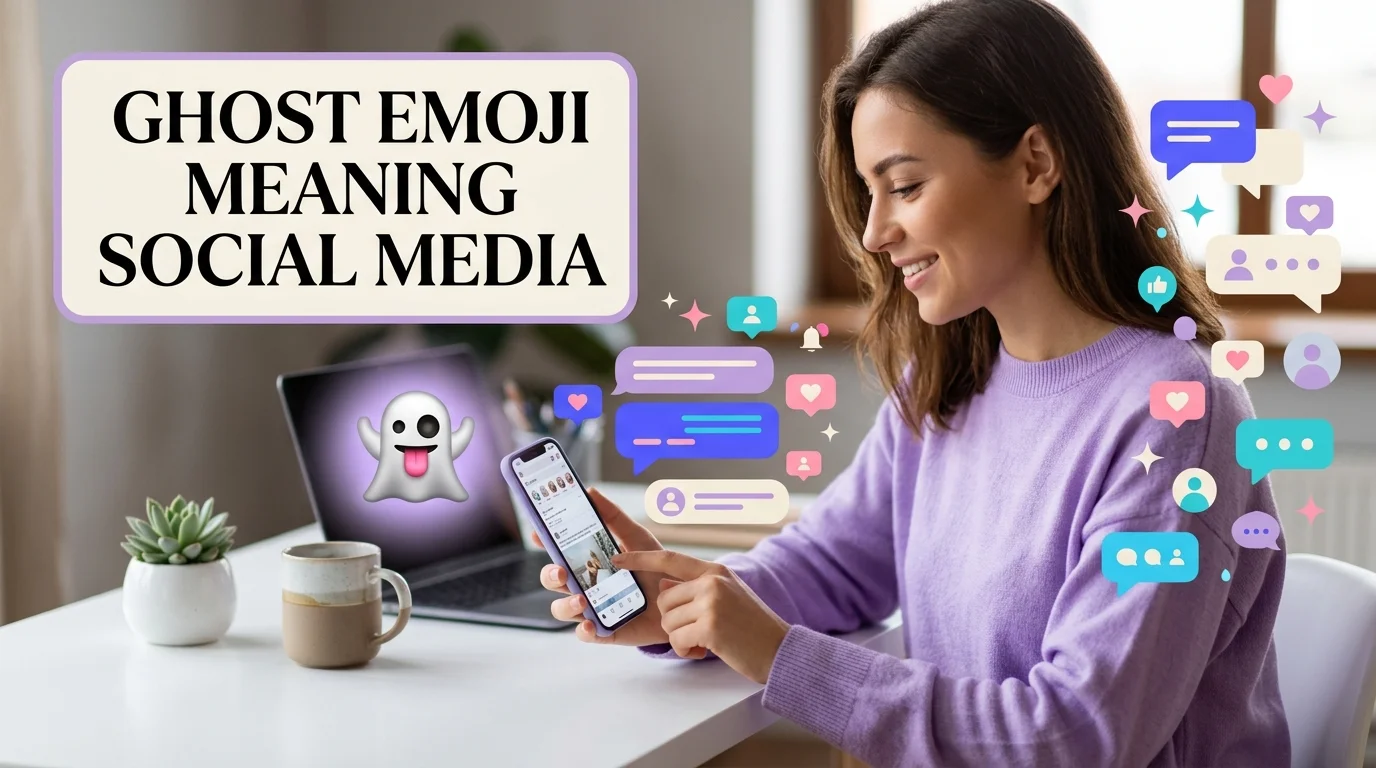
A ghost emoji can mean much more than something spooky, especially when it appears on social media. The ghost emoji meaning on social media often depends on the post, caption, and conversation. While 👻 can represent ghosts, Halloween, or something scary, people also use it to express playfulness, silliness, mystery, or a fun reaction.
In texting and social media comments, the 👻 emoji may sometimes suggest disappearing, avoiding someone, or “ghosting,” particularly when the conversation involves relationships or unanswered messages. On the other hand, it can simply add a cute, mischievous, or humorous feeling to a caption. Its meaning can change based on how and where someone uses it.
If you’re wondering what the ghost emoji means on social media, context is the key to understanding it. This guide explains its common meanings, popular uses, possible slang interpretations, and examples to help you understand what 👻 may communicate online.
👻 Ghost Emoji Meaning at a Glance
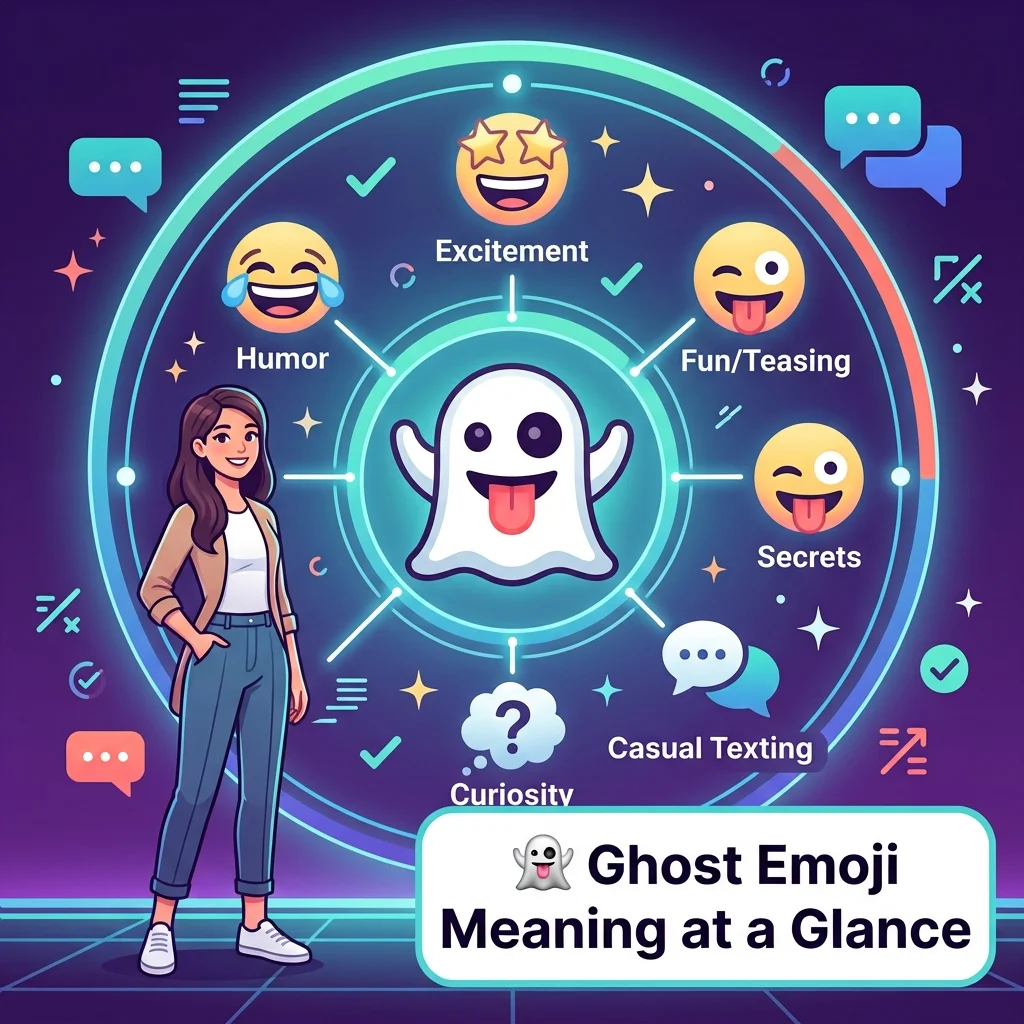
The ghost emoji 👻 usually represents a ghost, spooky feeling, mystery, playfulness, Halloween, fear, or disappearing from a conversation.
On social media, it can have several common meanings:
| Situation | Possible meaning of 👻 |
| Halloween | Spooky season, ghosts, costumes |
| Funny conversation | Playfulness or silliness |
| Scary topic | Fear or something creepy |
| After disappearing | “I disappeared” or “I’m back” |
| Dating conversation | Playful or teasing mood |
| Social media caption | Mystery, fun, or spooky aesthetic |
| Friendship | Joking around or being silly |
| Flirting | Playful teasing, depending on context |
| Ignoring someone | Can refer to “ghosting” |
| Meme or joke | Humor, irony, or exaggeration |
So, if someone sends you 👻, don’t automatically assume they’re talking about ghosts. Look at the entire conversation first.
What Does the Ghost Emoji 👻 Mean?
The ghost emoji 👻 is officially associated with a ghost-like character, but people use it far beyond the literal idea of a supernatural spirit.
In ordinary communication, it can express something spooky, strange, mysterious, funny, playful, or unexpected. The emoji also has a cute appearance, so people often use it without any serious connection to fear.
For example:
“I watched that horror movie alone 👻”
Here, 👻 adds a spooky or humorous feeling.
But consider:
“Sorry, I disappeared all weekend 👻”
In this case, the emoji can jokingly suggest that the person disappeared like a ghost.
Another example is:
“You really scared me 👻”
Here, the emoji supports the idea of being frightened while keeping the message light.
This flexibility explains why the ghost emoji appears so often in online conversations.
Ghost Emoji Meaning on Social Media
The ghost emoji meaning social media often depends on the type of post or interaction.
On Instagram, TikTok, Snapchat, Facebook, X, and other platforms, 👻 may appear in captions, comments, usernames, reactions, or private messages.
Someone might use it because they like a spooky aesthetic. Another person may use it as a joke about disappearing. Someone else might simply think the emoji looks cute.
👻 In Social Media Captions
The ghost emoji can make a caption feel mysterious, playful, or Halloween-themed.
For example:
“Out after dark 👻”
This could create a spooky or mysterious mood.
Another caption might say:
“Just here for the vibes 👻”
In this situation, the emoji probably isn’t about an actual ghost. It simply gives the caption a playful personality.
👻 In Comments
People sometimes use 👻 as a reaction to something funny, weird, surprising, or slightly creepy.
For example:
“That ending was inexplicable 👻”
The person may be saying that the ending surprised them or gave them a strange feeling.
A comment such as:
“Why would you do that? 👻”
could be teasing rather than genuinely angry.
👻 In Direct Messages
In DMs, the meaning becomes even more dependent on the conversation.
If someone says:
“Where have you been? 👻”
they may be joking about your absence.
If someone says:
“I know what you did 👻”
the emoji may add a teasing or mysterious tone.
That’s why reading the surrounding words is more useful than interpreting 👻 by itself.
Ghost Emoji Meaning in Texting
In texting, people often use the ghost emoji to add emotion to a message without writing a long explanation.
It can make a serious-looking sentence feel playful.
For example:
“I finally finished my homework 👻”
The emoji may simply make the statement funny or lighthearted.
Someone might also write:
“I’m going to bed. Bye 👻”
Here, the emoji can make the goodbye feel cute or playful.
Another common use relates to disappearing:
“Sorry, I’ve been a ghost lately 👻”
This means the person has been quiet, unavailable, or less active than usual.
In texting, the ghost emoji can therefore work almost like a tone marker. It tells the reader, “Don’t take this too seriously” or “I’m being playful,” depending on the context.
What Does 👻 Mean From a Girl?
When a girl sends 👻, there isn’t one universal interpretation.
She might use it because she thinks the conversation is funny, because she wants to create a spooky mood, or because she’s teasing you.
For example:
“You actually believed me? 👻”
This is likely playful teasing.
If she sends:
“I disappeared again 👻”
she may be joking about being inactive or taking a long time to reply.
In a friendly conversation:
“That movie was terrifying 👻”
the emoji probably reinforces the scary topic.
If you’re talking romantically, 👻 can sometimes add a playful or teasing tone. However, the emoji alone isn’t enough to prove romantic interest.
Look at the complete message, the previous conversation, and how that person normally communicates.
What Does 👻 Mean From a Guy?
A guy may use the ghost emoji to express humor, mystery, teasing, fear, or disappearing from a conversation.
For example:
“Don’t worry, I’m still alive 👻”
This could be a funny response after being away for a while.
He might also say:
“You scared me 👻”
Here, the emoji adds a playful feeling to the statement.
In a romantic conversation, a guy could use 👻 to tease or create a fun mood. But it doesn’t automatically mean flirting.
People use emojis differently. Some people add emojis to nearly every message, while others use them only when joking.
Ghost Emoji Meaning From a Crush
If your crush sends you 👻, it’s natural to wonder whether there is a hidden meaning.
Sometimes the emoji can make a conversation feel playful or flirty. For example:
“You really thought I’d forget you? 👻”
The ghost adds a teasing, slightly mysterious tone.
Another example:
“Maybe I’ll disappear for a little while 👻”
That could be a joke about taking a break from chatting.
However, don’t read too much into the emoji alone. A crush may use 👻 simply because they enjoy the emoji or because it fits the topic.
The surrounding conversation gives you much more information than the emoji itself.
👻 Ghost Emoji Meaning in Friendship
Among friends, 👻 is often casual and humorous.
Friends may use it when talking about disappearing, staying home, watching horror movies, or joking about something strange.
For example:
“I haven’t left my room all weekend 👻”
The emoji makes the statement sound humorous.
Another friend might text:
“You disappeared after the party 👻”
This could mean, “Where did you go?” in a playful way.
The emoji can also fit an inside joke between friends. If your group already uses 👻 in a particular way, that personal meaning can be more important than the general meaning.
👻 Ghost Emoji Meaning in a Romantic Relationship
Partners may use the ghost emoji to keep conversations light and playful.
For example:
“I miss you already 👻”
Depending on the relationship, this could sound cute and teasing.
A partner might also write:
“I’m coming to haunt you 👻”
This is generally playful rather than threatening when used between people who understand each other’s humor.
The ghost emoji can also appear during Halloween, movie nights, costume conversations, or jokes about scary situations.
In romantic communication, context matters especially strongly. The same emoji can feel affectionate between partners but completely ordinary between friends.
👻 Ghost Emoji Meaning When Someone Is Ghosting You
One of the more interesting uses of 👻 comes from the word ghosting.
“Ghosting” generally refers to suddenly stopping communication with someone without explaining why. Because of that connection, people sometimes use 👻 as a joke about disappearing.
For example:
“Sorry for ghosting you 👻”
This usually means:
“Sorry I disappeared and didn’t reply.”
Another example:
“He went full ghost mode 👻”
This means the person has become unusually quiet or stopped responding.
However, the emoji itself does not mean someone is ghosting you. You need the surrounding words and behavior to understand that meaning.
Friendly Meaning of the Ghost Emoji
The ghost emoji can have a completely friendly meaning.
Someone may send it simply to make a conversation more entertaining.
For example:
“Good luck with your exam tomorrow 👻”
Here, the emoji may simply add a quirky personal touch.
Or:
“See you later 👻”
This can be a playful goodbye.
If someone regularly uses 👻 with you, it may simply be part of their normal texting style.
Romantic Meaning of 👻
The ghost emoji can sometimes appear in romantic or flirty conversations, but it isn’t inherently a romantic emoji.
For example:
“You keep showing up in my thoughts 👻”
Here, the emoji creates a playful and slightly mysterious mood.
Another message could be:
“Stop being so cute 👻”
In this case, the emoji may support a teasing or flirtatious tone.
Still, you should not treat 👻 as a secret code for romantic attraction. A person can use the same emoji with friends, family members, or strangers.
The words, relationship, and overall conversation matter more.
Funny and Playful Meaning of 👻
One of the most common uses of 👻 is simply humor.
The emoji looks playful rather than terrifying, which makes it useful in jokes and memes.
For example:
“Me pretending I didn’t see your message 👻”
This joke uses the ghost as a visual representation of disappearing or avoiding a response.
Another example:
“When the teacher says there’s a surprise test 👻”
Here, the emoji exaggerates the student’s reaction.
In memes, 👻 can also represent awkwardness, surprise, embarrassment, or exaggerated fear.
Sarcastic Meaning of the Ghost Emoji
Sometimes 👻 is used sarcastically.
For example:
“Yeah, I’m totally not scared 👻”
If the situation is obviously scary, the emoji can make the sentence ironic.
Another example:
“I love getting ignored 👻”
Here, the ghost may emphasize the sarcastic tone.
Sarcasm can be difficult to understand through text because you cannot hear the speaker’s voice. Emojis often help provide a clue, but they don’t guarantee the exact intended tone.
Spooky and Halloween Meaning 👻
The most literal meaning of 👻 is still relevant.
During Halloween, people frequently use the ghost emoji in posts about:
- Costumes
- Haunted houses
- Horror movies
- Halloween parties
- Decorations
- Ghost stories
- Spooky photos
- Trick-or-treating
- Scary games
For example:
“Halloween is almost here 👻🎃”
In this context, the meaning is straightforward. The ghost represents the spooky Halloween theme.
A caption such as:
“Spooky season has arrived 👻”
also uses the emoji literally and culturally.
Mysterious Meaning of 👻
The ghost emoji can create a sense of mystery.
Social media creators sometimes use unusual or spooky emojis to make a caption feel less ordinary.
For example:
“Something is coming… 👻”
The ghost doesn’t necessarily mean an actual supernatural event. It can simply make the message feel mysterious.
Similarly:
“You weren’t supposed to see this 👻”
The emoji may add a playful secretive feeling.
Emotional Meaning of the Ghost Emoji
Although 👻 isn’t primarily an emotional emoji, it can sometimes communicate an emotional reaction indirectly.
Someone might use it when they feel:
- Awkward
- Embarrassed
- Nervous
- Surprised
- Scared
- Amused
- Confused
- Overwhelmed
For example:
“I accidentally sent the message to the wrong person 👻”
The ghost can communicate embarrassment or awkwardness.
Another example:
“I have to give a presentation tomorrow 👻”
Here, it could represent nervous humor.
Positive and Negative Interpretations of 👻
The ghost emoji can have both positive and negative interpretations.
Positive Interpretations
In a positive context, 👻 may communicate:
- Fun
- Humor
- Playfulness
- Excitement about Halloween
- Mystery
- A cute spooky aesthetic
- Friendly teasing
For example:
“Let’s watch a horror movie tonight 👻”
The emoji adds excitement to the idea.
Negative or Uncomfortable Interpretations
In another context, 👻 could refer to:
- Ignoring someone
- Ghosting
- Being unavailable
- Feeling scared
- Something creepy
- An awkward situation
For example:
“You left me on read again 👻”
Here, the emoji could emphasize the person’s frustration or teasing complaint.
The difference comes from context rather than the emoji itself.
Ghost Emoji Meaning in Different Situations
Here’s a quick comparison of how 👻 can change meaning:
| Context | Likely interpretation |
| Halloween post | Spooky/Halloween |
| Horror movie discussion | Fear or excitement |
| Friend disappears | Joking about being absent |
| Romantic chat | Playfulness or teasing |
| Instagram caption | Mystery or aesthetic |
| TikTok comment | Humor or reaction |
| “Sorry I ghosted” | Disappearing or ignoring |
| Meme | Comedy or exaggeration |
| Casual goodbye | Playful farewell |
| Awkward message | Embarrassment or humor |
These aren’t strict definitions. They’re common possibilities.
Real Texting Examples With 👻
Seeing examples is one of the easiest ways to understand emoji meanings.
Example 1: Friend Disappearing
Friend: “Where have you been all day?”
You: “Sleeping like a ghost 👻”
Here, the emoji makes the answer playful.
Example 2: Halloween
Friend: “Are you dressing up this year?”
You: “Of course 👻🎃”
The emoji clearly connects to Halloween.
Example 3: Horror Movie
You: “That movie was way too scary.”
Friend: “You were screaming the whole time 👻”
Here, the emoji adds humor.
Example 4: Romantic Teasing
Person A: “You can’t get rid of me.”
Person B: “Are you sure about that? 👻”
The emoji gives the reply a playful, teasing tone.
Example 5: Disappearing From Chat
Friend: “You haven’t replied in two days.”
You: “Sorry! I’ve been a ghost lately 👻”
Here, 👻 connects directly to being absent.
Example 6: Social Media Comment
Post: “Me entering the kitchen at midnight.”
Comment: “The fridge knows you’re coming 👻”
The emoji supports the joke.
Example 7: Awkward Situation
You: “I accidentally called my teacher ‘Mom.’ 👻”
Here, the emoji represents embarrassment and humor.
How to Respond When Someone Sends 👻
Your response should match the conversation.
You don’t need to respond with another ghost emoji unless you want to. A normal sentence can work just as well.
If a Friend Sends 👻
Keep it casual:
“Haha, what does that mean? 😂”
Or:
“You’re being weird again 👻😂”
If Your Crush Sends 👻
If the conversation is playful, you can respond with similar energy:
“Why are you being mysterious? 👀”
Or:
“Okay, now I’m curious 😂”
These responses keep the conversation moving without assuming too much.
If Your Partner Sends 👻
You can match their playful mood:
“Trying to haunt me again? 😂”
Or:
“You’re such a ghost 👻❤️”
The best response depends on your existing relationship and communication style.
If You Don’t Understand the Meaning
Simply ask:
“What does the ghost mean? 😂”
There’s nothing wrong with asking. In fact, asking is often better than guessing.
Should You Reply With 👻?
You can reply with 👻 if the conversation has a playful, spooky, funny, or mysterious tone.
For example:
Them: “I watched a horror movie alone 👻”
You: “Brave choice 👻😂”
That feels natural because you’re matching the topic.
However, if someone is discussing a serious problem, using a ghost emoji may send the wrong message. Always consider the emotional tone before choosing an emoji.
Ghost Emoji vs. Other Similar Emojis
Several emojis can look or feel similar to 👻, but they aren’t interchangeable in every situation.
| Emoji | Common idea | Difference from 👻 |
| 👻 | Ghost, spooky, playful, disappearing | Broad and playful |
| 💀 | Death, shock, extreme humor | Often used for “I’m dead” from laughter |
| ☠️ | Danger, death, skull-and-crossbones | Stronger and more serious |
| 🎃 | Halloween, pumpkin, autumn | More specifically Halloween-themed |
| 😱 | Fear or shock | Focuses directly on emotional reaction |
| 🫣 | Shyness, embarrassment | More focused on hiding or awkwardness |
| 😈 | Mischief or teasing | More mischievous than spooky |
| 🕷️ | Spider, creepy/spooky theme | More specific to spiders |
For example, if you want to say that something made you laugh extremely hard, 💀 may fit better than 👻.
If you’re talking about Halloween, 👻 and 🎃 can both work, but they create slightly different imagery.
Common Misunderstandings About 👻
Does 👻 Always Mean Ghosting?
No.
The ghost emoji can refer to ghosting, but it can also simply mean spooky, funny, mysterious, or playful.
Does 👻 Mean Someone Is Flirting?
Not necessarily.
A person may use 👻 while flirting, but the emoji itself doesn’t establish romantic interest.
Is 👻 a Negative Emoji?
No.
It can have a negative interpretation in some conversations, but it is frequently used in positive and humorous situations.
Does 👻 Mean Someone Is Scared?
Sometimes, but not always.
If the conversation involves horror or fear, it may represent being scared. In other situations, it can have nothing to do with fear.
Does 👻 Mean “I’m Ignoring You”?
It can, especially when people are joking about ghosting. However, you shouldn’t assume that meaning without context.
Why Context Matters With Emoji Meanings
Emoji communication works differently from dictionary definitions.
A dictionary can tell you what an emoji represents visually, but it cannot tell you exactly what another person intends in every conversation.
Consider this message:
“I’m back 👻”
It could mean the person returned after being away.
Now consider:
“That house looks haunted 👻”
Here, the meaning is clearly spooky.
And:
“Sorry for ghosting you 👻”
Now the emoji relates to disappearing from communication.
The emoji hasn’t changed. The context has.
Your relationship with the sender matters too. A close friend may use 👻 as an inside joke, while someone you barely know may use it simply because they like spooky emojis.
Ghost Emoji Meaning Across Social Media Platforms
Different platforms can encourage different styles of emoji use.
On Snapchat, 👻 can naturally fit conversations involving disappearing, since the platform itself has a strong association with temporary and visual communication.
On Instagram, people may use 👻 in captions, comments, Stories, and DMs to create a funny or spooky aesthetic.
On TikTok, the emoji can appear in comments reacting to strange, funny, awkward, or unexpected videos.
On WhatsApp, it often works like a normal conversational emoji and can represent humor, teasing, fear, or disappearing.
The same basic emoji can therefore take on different meanings depending on the type of content and community using it.
How Culture and Personal Style Affect 👻
Emoji meanings aren’t identical for everyone.
Some people use emojis literally. Others use them sarcastically. Some people use an emoji because it looks cute, while others choose it specifically to communicate an emotion.
Cultural differences can also influence how people interpret digital communication. Even among people who speak the same language, texting habits can vary significantly.
For this reason, you should avoid treating an emoji as a secret universal code.
If someone sends 👻 and you aren’t sure what they mean, consider the message before and after it. That usually gives you a much clearer answer.
Is the Ghost Emoji Cute?
Many people consider 👻 a cute rather than frightening emoji.
Its friendly appearance makes it suitable for casual conversations, social media captions, Halloween posts, memes, and playful messages.
That’s why someone might use it even when nothing scary is happening.
For example:
“Good morning 👻”
There may be no spooky meaning at all. The person may simply enjoy the look of the emoji.
When Should You Avoid Using 👻?
The ghost emoji is generally casual, so it may not fit every situation.
You may want to avoid it when:
- You’re writing a formal business message.
- Someone is sharing serious personal news.
- You’re discussing a sensitive issue.
- The recipient may misunderstand your joke.
- You need your message to sound completely serious.
For example, if someone tells you they’re dealing with a difficult situation, responding with 👻 could make your message seem dismissive.
In casual communication, however, it can be a fun way to add personality.
A Simple Way to Understand 👻
If you want to decode the ghost emoji quickly, ask yourself three questions:
What are we talking about?
If you’re discussing Halloween or horror, 👻 probably has a spooky meaning.
What is the tone?
If the conversation is full of jokes, 👻 probably adds humor or playfulness.
What is my relationship with this person?
A friend, crush, partner, and stranger may use the same emoji differently.
These three clues can help you understand the intended meaning without overthinking it.
Final Takeaway:
The ghost emoji meaning social media is flexible. 👻 can represent a literal ghost, Halloween, fear, mystery, humor, playful teasing, disappearing from a conversation, or even the idea of ghosting.
In texting and social media, the emoji usually adds personality and tone rather than communicating one exact message. It can be cute, funny, spooky, sarcastic, mysterious, or occasionally related to romantic teasing.
FAQs About Ghost Emoji Meaning Social Media
What does the ghost emoji 👻 mean on social media?
The ghost emoji 👻 can mean spooky, mysterious, funny, playful, or related to disappearing or ghosting. Its exact meaning depends on the post, message, and context.
What does 👻 mean in texting?
In texting, 👻 can add a playful or spooky tone. People may use it when talking about Halloween, fear, jokes, disappearing, awkward moments, or something mysterious.
Does the ghost emoji mean ghosting?
Sometimes. People may use 👻 to joke about ghosting or disappearing from a conversation. However, the emoji doesn’t automatically mean that someone is ignoring you.
What does 👻 mean from a girl?
A girl may use 👻 to express humor, teasing, mystery, fear, or a spooky mood. In a romantic conversation, it can sometimes feel playful or flirty, but the emoji alone doesn’t prove romantic interest.
What does 👻 mean from a guy?
A guy may use 👻 to joke, tease, express fear, create a mysterious mood, or refer to disappearing from a chat. The meaning depends on the conversation and his normal communication style.
Does 👻 mean flirting?
Not necessarily. The ghost emoji isn’t inherently a flirting emoji. It can appear in a flirty conversation, but it is also very common in friendly, funny, casual, and Halloween-related conversations.
Is the ghost emoji positive or negative?
It can be either, depending on context. 👻 is often playful or humorous, but it can also refer to ghosting, fear, awkwardness, or something creepy.
What should I reply when someone sends 👻?
Match the tone of the conversation. You could send a playful response such as “Why are you being mysterious? 😂” or simply ask, “What does the ghost mean?” if you’re unsure.

I am James Wilson, a passionate writer dedicated to creating informative, engaging, and valuable content for readers around the world. I am focused on sharing well-researched ideas, practical insights, and helpful information that inspires learning and growth. With a strong interest in writing and exploring different topics, I aim to provide content that is clear, meaningful, and easy to understand.