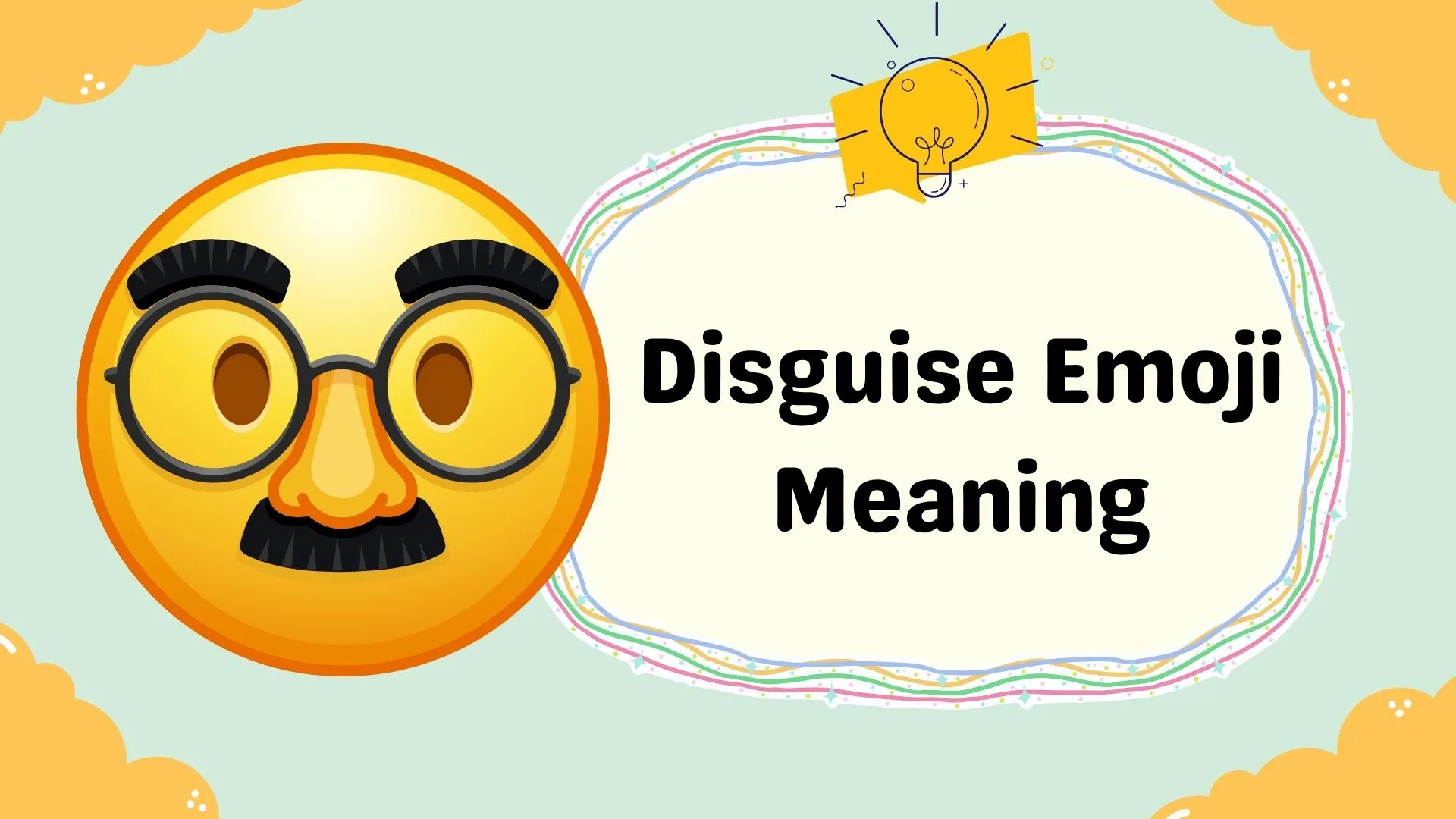
The disguise emoji 🥸 is a fun and expressive emoji that usually represents hiding your identity, pretending, being sneaky, or trying to look different. With its fake glasses, big nose, and mustache, 🥸 can instantly add a humorous or mysterious feeling to a message.
People often use it when they are joking about going undercover, keeping a secret, avoiding recognition, or pretending to be someone else. However, its meaning can change depending on the conversation.
In texting, 🥸 might suggest “You won’t recognize me,” while in a playful conversation, it can simply mean someone is being silly or mischievous. It can also be used to make a message sound less serious or create a funny reaction.
Quick Answer
The disguise emoji 🥸 (officially “Disguised Face”) shows a yellow face wearing oversized glasses, a big fake nose, bushy eyebrows, and a mustache. Most people use it to signal going undercover, playful secrecy, mild mischief, or a deliberately unconvincing “wasn’t me.” Context decides whether it feels funny, mysterious, or a little shady.
Table of Contents
- Disguise Emoji Mean
- Spiritual Meaning
- Biblical Meaning
- Psychological Meaning
- Emotional Meaning
- Positive Meanings
- Negative Meanings
- Common Usage Scenarios
- Cultural Interpretations
- Is This Emoji Good or Bad?
- What Should You Do After Seeing or Using This Emoji?
- Comparison Table
- FAQs
- Final Thoughts
What Does the Disguise Emoji Mean?
The disguise emoji 🥸 is a bright yellow face wearing classic novelty “Groucho glasses.” These are the same joke-shop props that combine thick black frames, a plastic nose, fake eyebrows, and a mustache. Unicode named it “Disguised Face” when it arrived in 2020 as part of Emoji 13.0.
At its simplest, the emoji says “I am in disguise” or “nothing to see here.” Because the disguise is so cartoonish and obvious, the message usually stays light. It rarely signals serious espionage. Instead it highlights the comedy of trying (and failing) to hide.
Emotionally it can show someone feeling awkward and wanting to disappear, or someone feeling clever and playful. Symbolically it points to the gap between the face we show and the feelings we keep private. Practically it works as a soft denial, a way to flag gossip, or a quick signal that a story is not completely serious.
Many people treat the emoji as a digital version of putting on a silly costume. The message is rarely meant to fool anyone completely. The humor comes from the fact that the disguise is transparent.
Spiritual Meaning
Some people look at symbols through a spiritual lens even when the symbol is modern. The disguise emoji can remind users of the idea that we all wear masks in daily life. In certain mindfulness or spiritual conversations, the emoji appears when someone talks about removing a social mask and showing a more authentic self.
Others connect it to the notion of a “blessing in disguise.” The same face that hides can also protect or open unexpected doors. A few online communities use 🥸 when discussing hidden spiritual lessons or the idea that truth sometimes travels under cover.
These readings stay personal. The emoji itself carries no official spiritual doctrine. Any deeper meaning comes from the user’s own beliefs and the surrounding conversation.
Biblical Meaning
The Bible does not mention emojis or Groucho glasses. There is no direct biblical association with the disguise emoji.
Some readers might loosely connect the idea of disguise to stories of people who changed appearance for protection or purpose, such as certain Old Testament accounts of concealment. Those links remain interpretive stretch rather than established symbolism. Most faith-based discussions simply note that the emoji is a modern secular symbol and leave it at that.
Psychological Meaning
Modern psychology helps explain why the disguise emoji feels satisfying to send. Humans naturally manage how much of themselves they reveal. Social media and group chats increase the pressure to perform. The 🥸 offers a low-stakes way to admit “I am not showing my full self right now.”
It can reflect mild anxiety about being seen, the desire for privacy, or the pleasure of mild rule-breaking. When someone uses it after a mistake, the emoji softens the admission of guilt. When they use it while watching a situation quietly, it signals observational curiosity rather than open participation.
The emoji also taps into role-playing. People enjoy trying on different personas. Typing 🥸 can feel like slipping into a temporary character, spy, prankster, or awkward bystander, without lasting consequences. In that sense the emoji serves as a tiny psychological pressure valve.
Emotional Meaning
The disguise emoji often carries mixed but mostly light emotions. Common feelings include:
- Playfulness and mischief
- Mild embarrassment or the urge to hide
- Quiet curiosity or “I’m watching” energy
- Gentle sarcasm
- A sense of not quite belonging in the moment
It rarely signals deep anger or sadness. The cartoon features keep the tone from becoming heavy. When the emoji appears after a tense message, it can function as a softener, telling the other person “I’m not taking this completely seriously.”
Positive Meanings
Many positive uses surround the disguise emoji:
- Adding humor to an otherwise ordinary chat
- Signaling a harmless prank or surprise
- Celebrating costumes, Halloween, or dress-up events
- Softening a confession so it feels less confrontational
- Showing creativity or willingness to play
- Marking private observation without judgment
- Expressing “incognito mode” in a fun way while browsing or people-watching
These readings treat the emoji as a friendly wink rather than a serious mask.
Negative Meanings
Context can tilt the emoji toward less comfortable territory:
- Suggesting someone is hiding real feelings or information
- Hinting at mild deception or white lies
- Flagging suspicion or the sense that something is “off”
- Implying the speaker feels like an outsider or impostor
- Softening responsibility in a way that avoids accountability
Even in negative moments the cartoon style usually keeps the tone from turning fully hostile. Still, repeated use during serious talks can make others wonder what is being left unsaid.
Common Usage Scenarios
Here are seven everyday situations where the disguise emoji appears, with possible readings.
Using 🥸 After Getting Caught
Someone messes up, eats the last cookie, forgets a deadline, or posts the wrong photo, and replies with 🥸. The emoji acts as a playful “you got me.” Interpretation stays mostly positive because the admission is open, just wrapped in humor. Neutral to lightly positive.
Using 🥸 While Lurking in a Group Chat
A person reads everything but rarely posts. When they finally speak they add 🥸. It can mean “I’ve been here the whole time, just quiet.” Many read this as mild social anxiety or simple observation. Generally neutral.
Using 🥸 for a Planned Surprise
Friends organize a party or gift and use the emoji in planning messages. It signals secrecy with excitement rather than malice. Clear positive meaning.
Using 🥸 to Soften a Denial
“I have no idea who left the dishes in the sink 🥸.” Everyone knows the speaker did it. The emoji turns potential conflict into shared laughter. Positive when the group shares the joke; slightly negative if the denial feels chronic.
Using 🥸 During Costume or Halloween Talk
People post outfit ideas or party photos with 🥸. Here the emoji is literal and festive. Strongly positive.
Using 🥸 in Online Gaming or Impostor Contexts
During games that involve hidden roles (Among Us and similar), the emoji marks the “impostor” feeling. It can feel competitive or conspiratorial. Neutral to playfully negative depending on the game tone.
Using 🥸 When Feeling Out of Place
Someone joins a new workplace chat or family group and feels awkward. Adding 🥸 to a message can express “I’m still figuring out how to fit in.” Often a quiet call for patience. Neutral with a gentle emotional undertone.
Cultural Interpretations
Western internet culture treats the emoji as pure comedy rooted in the Groucho Marx novelty glasses. The joke is that the disguise is terrible and therefore funny.
In many English-speaking online spaces it also links to “incognito” browsing or anonymous gossip. Some gaming communities adopted it for impostor roles. Halloween and costume culture worldwide give it seasonal popularity.
Islamic, Hindu, Chinese, or Indigenous traditions do not carry traditional meanings for this modern emoji. Any cultural reading stays secondary to local internet humor and platform norms. The symbol travels well precisely because its visual joke is easy to understand across languages.
Is This Emoji Good or Bad?
The disguise emoji is neither purely good nor purely bad. Its value depends on timing and relationship. In close friendships it almost always lands as playful. In professional settings or tense conversations it can raise questions about transparency.
Most of the time the cartoon features keep it on the lighter side of the spectrum. Think of it as a tool rather than a fixed sign. The same emoji can celebrate creativity one day and gently dodge responsibility the next.
What Should You Do After Seeing or Using This Emoji?
Pause and notice the full message. Ask yourself whether the emoji softens a joke or hides something important. If you sent it, consider whether the humor matched the moment.
When the emoji appears in a sensitive chat, a simple clarifying reply often works better than matching the tone. If you enjoy the playful energy, lean into it with another light emoji or a matching joke. Reflection helps keep digital conversations clearer and kinder.
Comparison Table
| Positive Symbolism | Negative Symbolism |
| Playful humor | Mild deception |
| Creative role-play | Avoidance of responsibility |
| Light secrecy for surprises | Suspicion or hidden motives |
| Softening awkward moments | Feeling like an outsider |
| Costume and party fun | Chronic lack of transparency |
| Observational curiosity | Softening real conflict |
FAQs
What does the disguise emoji mean in texting?
It usually means the sender is joking about hiding, denying something playfully, or feeling a bit sneaky. Context and the rest of the message decide the exact tone.
Is the disguise emoji the same as the monocle emoji?
No. The monocle emoji 🧐 looks more thoughtful or skeptical. The disguise emoji 🥸 focuses on the fake nose, glasses, and mustache combo.
When did the disguise emoji appear?
It joined Unicode and the official emoji set in 2020 as part of version 13.0.
Can the disguise emoji mean someone is lying?
Sometimes people use it for soft, obvious denials. It rarely signals serious lies; the cartoon style keeps most uses light.
Does the disguise emoji work for Halloween?
Yes. Many people pair it with costume talk, party invitations, or photos of silly outfits.
What platforms support the disguise emoji?
All major platforms (Apple, Google, Samsung, Microsoft, and others) have displayed it since 2020, though the exact art style varies slightly.
Final Thoughts
The disguise emoji 🥸 thrives because it captures a very human impulse: the wish to hide for a moment without really disappearing. Its comedy comes from the fact that the mask is so obvious. Meanings shift with every chat.
What feels like a shared joke to one pair of friends can feel slightly evasive to another. The most useful approach is simple curiosity. Notice how the emoji lands in your own conversations, and let that observation guide how you use it next time. Personal experience always shapes the final reading more than any fixed list of symbols.

I am Grace Wilson, a passionate writer dedicated to creating helpful, engaging, and informative content for readers around the world. I am committed to sharing well-researched ideas, practical knowledge, and meaningful stories that inspire and educate. With a focus on clarity and authenticity, I am always exploring new topics and bringing valuable insights to my audience.