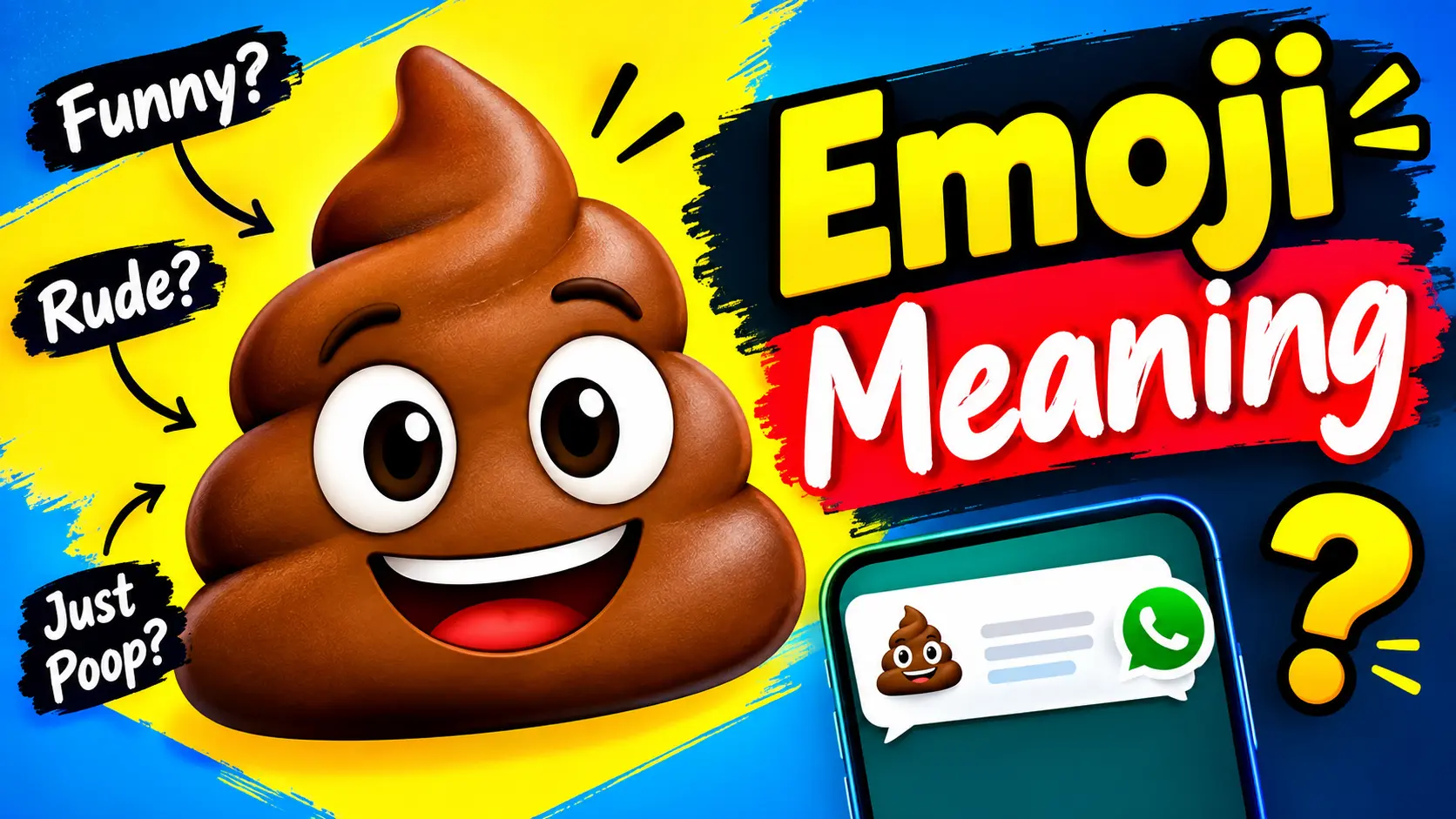
It’s hard to miss the meaning behind 💩 at first glance, but this funny emoji can say more than just “poop.” The 💩 emoji meaning can be literal when someone is talking about poop, toilets, or something gross.
However, people often use it in texting and social media as a playful way to describe something silly, messy, bad, annoying, or ridiculous. Its humorous design also makes it popular when friends are joking around or teasing each other.
The meaning can change depending on the conversation and the relationship between the people using it. Someone might send 💩 after making a silly mistake, reacting to a bad situation, or joking about something embarrassing.
What Does the 💩 Emoji Mean?
The 💩 emoji is commonly called the poop emoji, poo emoji, or pile of poo emoji. Its basic visual meaning is exactly what it shows: a smiling pile of poop.
In everyday digital communication, though, it has several meanings. People often use it to describe something bad, silly, messy, embarrassing, ridiculous, or funny.
Here are some common interpretations:
| Meaning | What it can communicate |
| Literal poop | Talking about bathroom humor or bodily functions |
| Something bad | Saying something is terrible or low quality |
| Humor | Making a situation less serious |
| Sarcasm | Mocking something or someone playfully |
| Insult | Calling something or someone “crap” |
| Embarrassment | Reacting to an awkward situation |
| Mess | Describing a chaotic or difficult situation |
| Playfulness | Using childish or silly humor |
| Frustration | Showing annoyance with something |
| Self-deprecating humor | Making fun of yourself |
The smiling face makes the emoji feel different from a plain negative statement. Instead of simply saying “That is terrible,” someone might write “That was 💩 😂,” which can make the criticism sound more humorous.
💩 Emoji Meaning in Text Messages
In text messages, the 💩 emoji often works as an emotional shortcut. Instead of writing several words to explain that something is terrible, ridiculous, or funny, a person can use one emoji.
For example:
Person A: “How was the restaurant?”
Person B: “Honestly, the food was 💩.”
Here, the sender probably means the food was very bad.
But consider another example:
Friend: “I forgot my homework again 💩.”
Here, the emoji expresses frustration or embarrassment rather than literally referring to poop.
The surrounding words matter. A single 💩 can have a completely different meaning from “This is 💩,” “You’re 💩,” or “Oops 💩.”
💩 Emoji Meaning on Social Media
On social media, people commonly use the 💩 emoji in comments, captions, replies, memes, and reactions.
It can be used to make a post more humorous or to react to something ridiculous. For example, someone might post about a terrible day and add 💩 to show that everything went wrong.
A social media comment such as:
“What a 💩 show 😂”
usually means the situation is chaotic, badly organized, or ridiculous.
People may also use 💩 alongside laughing emojis to show that they are joking rather than making a serious insult.
On platforms such as Instagram, TikTok, Snapchat, and messaging apps, the emoji can therefore function as a humorous reaction, not just a literal symbol.
💩 Emoji Meaning in Friendship
Among friends, the 💩 emoji is often playful.
Close friends may use exaggerated or childish humor with each other because they already understand one another’s communication style. A friend might send:
“Bro, your cooking is 💩 😂”
This could sound rude between strangers. Between close friends, however, it may simply be teasing.
Another example:
“I completely messed up that presentation 💩.”
Here, the friend may use the emoji to laugh at their own mistake.
The important point is that friendship changes how an emoji feels. The same symbol can sound affectionate and funny in one friendship but insulting in another.
💩 Emoji Meaning in Romantic Relationships
Couples may use the 💩 emoji in playful conversations, especially when they already have a relaxed communication style.
For example:
“I burned dinner again 💩😭.”
A partner might respond:
“Still eating it 😂💩.”
In this situation, the emoji adds humor to an ordinary conversation.
However, 💩 does not automatically have a romantic meaning. Unlike ❤️, 😘, 🥰, or 💕, it is not generally recognized as a romantic symbol.
If someone you are dating sends 💩, the meaning usually comes from the surrounding conversation rather than the emoji itself.
💩 Emoji Meaning From a Girl
If a girl sends you 💩, there is no universal hidden meaning.
She could be joking, reacting to something unpleasant, describing a bad situation, teasing you, or simply using the emoji because she finds it funny.
For example:
You: “I studied for six hours and the exam covered nothing I studied.”
Her: “💩😂”
She may simply be reacting humorously to your bad luck.
If she sends:
“Your joke was 💩 😂”
she is probably teasing you about the joke.
The best way to understand her meaning is to consider what she wrote before or after the emoji and how she normally communicates with you.
💩 Emoji Meaning From a Guy
A guy sending 💩 may use it in much the same way.
Guys often use the emoji for jokes, teasing, frustration, or reactions to something ridiculous. However, you should not assume that every use has the same meaning.
For example:
“That movie was 💩.”
This most likely means he thought the movie was bad.
But:
“I forgot your birthday 💩💩💩.”
could express embarrassment or regret in a joking way.
And:
“Bro, you’re full of 💩 😂.”
is commonly a playful accusation that someone is exaggerating, lying, or talking nonsense.
💩 Emoji Meaning From a Crush
If your crush sends you 💩, it does not automatically mean flirting.
The emoji itself has no standard romantic message. Your crush might use it because they are comfortable joking with you, but you need more context before interpreting that as romantic interest.
Consider these examples:
You: “I just fell asleep during the movie.”
Crush: “You’re terrible 💩😂”
This could simply be playful teasing.
Another example:
You: “I think my cooking deserves five stars.”
Crush: “More like 💩😂.”
Again, this is probably humor.
If you want to understand whether the conversation has a romantic tone, look at the overall communication pattern, not one emoji.
💩 Emoji Meaning From a Partner
Partners can use 💩 to make everyday conversations less formal.
For example:
“The baby woke me up at 4 AM 💩.”
The emoji could express tiredness and frustration.
Or:
“I forgot to buy milk again 💩.”
Here, the emoji adds a humorous sense of self-blame.
In some relationships, partners may even use the emoji as part of an inside joke. That meaning may be completely specific to the couple and impossible to understand from the emoji alone.
Friendly Meaning of 💩
The friendly use of 💩 usually involves joking, teasing, or shared humor.
Someone may send it after a friend makes an obvious mistake:
“You really locked your keys inside the car? 💩😂”
The sender probably isn’t seriously insulting the person. They are laughing at the situation.
Another example:
“I sent the email to the wrong person 💩.”
Here, the emoji communicates embarrassment in a casual way.
Romantic Meaning of 💩
The 💩 emoji does not have a standard romantic meaning.
Someone could use it while flirting, but the romantic message would come from the conversation rather than the emoji itself.
For example:
“You are so annoying 💩❤️.”
The ❤️ changes the emotional context.
Without additional context, 💩 should generally be understood as humorous, silly, negative, or playful, rather than romantic.
Emotional Meaning of 💩
The 💩 emoji can express several emotions, including:
- Frustration
- Embarrassment
- Disappointment
- Annoyance
- Amusement
- Self-mockery
- Awkwardness
- Disbelief
For example:
“I missed the bus again 💩.”
This can mean, “Ugh, that’s annoying.”
Meanwhile:
“I just called my teacher ‘Mom’ 💩😭.”
Here, it expresses embarrassment.
The emoji doesn’t identify one specific emotion. It adds emotional flavor to the message.
Funny or Playful Meaning of 💩
One of the most common uses of 💩 is simple silliness.
The poop emoji has a naturally childish and humorous appearance. People may use it because the subject itself is funny, immature, or ridiculous.
For example:
“Guess what I found in my shoe 💩😂.”
Or:
“This conversation has officially gone to 💩.”
In these situations, the emoji keeps the conversation light.
Sarcastic Meaning of 💩
The emoji can also carry sarcasm.
Suppose someone says:
“I love waiting two hours for customer service 💩.”
The sender probably does not genuinely love waiting. The emoji reinforces the sarcastic tone.
Another example:
“Amazing job breaking it on the first day 💩👏.”
The sender is likely joking about the mistake.
Sarcasm depends heavily on context, so a person unfamiliar with the sender’s humor could interpret the message differently.
Negative Meaning of 💩
Sometimes 💩 is genuinely negative.
It can mean:
- Something is terrible.
- A person is behaving badly.
- A situation is going badly.
- Something is low quality.
- The sender is annoyed.
For example:
“This phone update is 💩.”
The sender is criticizing the update.
Similarly:
“My day has been 💩.”
The sender is saying their day has been awful.
Because the emoji resembles the slang word crap, it can sometimes function as a softer or more humorous version of an insult.
Positive or Harmless Meaning of 💩
Although the emoji has a negative-looking subject, its use isn’t always negative.
People may send it simply because they are joking.
For example:
“Look at this tiny dog 😂💩.”
The emoji might be part of a silly reaction rather than an insult.
Someone could also use 💩 in an inside joke that has a positive meaning within their friend group.
This is why looking at the literal image alone isn’t enough.
What Does 💩 Mean When Someone Sends It Alone?
A single 💩 can be difficult to interpret.
Depending on the conversation, it might mean:
- “That is terrible.”
- “What a mess.”
- “That’s hilarious.”
- “Oops.”
- “I’m embarrassed.”
- “That’s ridiculous.”
- “What the heck?”
- “I’m joking.”
For example, if you tell your friend:
“I accidentally deleted the entire project.”
and they respond:
“💩”
they might be reacting to the disaster.
But if you send a funny meme and they respond:
“💩😂”
they are probably laughing.
A one-emoji message needs conversational context more than almost any ordinary sentence.
💩 Emoji Meaning in Different Situations
| Situation | Possible meaning |
| Bad food | “This food is terrible.” |
| Failed exam | “That went badly.” |
| Embarrassing mistake | “Oops, I’m embarrassed.” |
| Friend’s joke | Playful teasing |
| Bad movie | “This movie is awful.” |
| Chaotic event | “What a mess.” |
| Funny meme | Silly humor |
| Argument | Possible insult or frustration |
| Self-made mistake | Self-deprecating humor |
| Casual chat | Random playful humor |
These are common interpretations, not fixed rules. Emoji meaning changes with context.
Real Texting Examples With 💩
Example 1: Bad Experience
A: “How was your flight?”
B: “Delayed for five hours 💩.”
Here, 💩 expresses frustration about the bad experience.
Example 2: Playful Teasing
A: “I scored 100% on the quiz.”
B: “Okay genius 💩😂.”
Here, the emoji adds playful teasing.
Example 3: Self-Deprecation
A: “I forgot my own password again 💩.”
The sender is making fun of their own mistake.
Example 4: Bad Quality
A: “Did you like the new update?”
B: “Honestly? 💩.”
The emoji means the sender strongly dislikes the update.
Example 5: Embarrassment
A: “I waved back at someone who wasn’t waving at me.”
B: “NOOO 💩😭.”
Here, the emoji reinforces the embarrassment.
Example 6: Sarcasm
A: “Another meeting that could have been an email.”
B: “Sounds amazing 💩.”
The emoji makes the sarcasm obvious.
Example 7: Random Humor
A: “What are you doing?”
B: “Thinking about 💩 😂.”
This may simply be childish humor between friends.
How to Respond When Someone Sends 💩
Your response should depend on the situation.
If a friend sends 💩 after telling you about a bad experience, you could respond:
“What happened? 😂”
or:
“That bad?”
If they’re joking:
“Bro 😂”
or:
“You’re ridiculous.”
If your crush sends it after teasing you, you could keep the tone playful:
“Wow, rude 😂”
or:
“You really had to use the 💩 emoji? 😂”
If your partner sends it after making a mistake:
“It happens 😂.”
or:
“Don’t worry, we’ll fix it.”
If you aren’t sure what they mean, the simplest response is:
“What does that mean? 😂”
There is nothing wrong with asking for clarification. Emoji interpretation can be uncertain, especially when the message contains no other words.
How to Respond to 💩 From a Friend
If the message is clearly playful, match the casual tone.
Some natural responses include:
- “Bro 😂”
- “What happened?”
- “That bad?”
- “LMAO”
- “You’re so dramatic 😂”
- “I knew it 💀”
- “Okay, that’s actually funny.”
Your response should fit the existing conversation rather than forcing a particular interpretation.
How to Respond to 💩 From a Crush
If your crush uses 💩 jokingly, you can respond with light humor.
For example:
“Excuse me? 😂”
“That’s your response? 😂”
“You’re lucky I like you.”
The last response is more openly flirty, so use it only if that kind of tone already exists between you.
Don’t treat the emoji itself as proof of romantic interest.
How to Respond to 💩 From a Partner
With a partner, you can respond based on whether the emoji represents humor, frustration, or a real problem.
For example:
Partner: “I forgot to pick up dinner 💩.”
You: “It’s okay. I’ll order something 😂.”
Or:
Partner: “Work was 💩 today.”
You: “Rough day? Want to talk about it?”
The second response recognizes that the emoji may represent genuine frustration rather than just a joke.
Similar Emojis and How They Differ
Several emojis can appear in similar humorous or negative conversations.
| Emoji | Common use |
| 💩 | Poop, nonsense, bad situation, humor |
| 💀 | Extreme laughter, shock, disbelief |
| 🤡 | Foolish behavior, self-mockery, calling something ridiculous |
| 😭 | Strong laughter, sadness, emotional reaction |
| 😂 | Laughter |
| 🤦 | Frustration or disbelief |
| 😬 | Awkwardness or discomfort |
| 🗑️ | Something being treated as trash or worthless |
The 💩 emoji stands out because its humor comes from the literal idea of poop. It often communicates “crap,” “mess,” or “this is terrible” in a playful way.
💩 vs. 💀
These two emojis can both appear in funny conversations, but they usually serve different purposes.
💩 often points toward something bad, ridiculous, messy, or literally poop-related.
💀 often means that something is extremely funny, shocking, or unbelievable.
For example:
“That movie was 💩.”
means the movie was terrible.
But:
“That movie scene killed me 💀.”
usually means the scene was extremely funny or shocking.
💩 vs. 🤡
The 🤡 emoji often focuses on foolish behavior or someone looking foolish.
For example:
“I trusted him again 🤡.”
This suggests the sender feels foolish.
Meanwhile:
“That plan was 💩.”
focuses more on the quality of the plan.
The two can appear together when someone wants to joke about a bad decision.
💩 vs. 🗑️
The 🗑️ emoji represents a trash can and can be used metaphorically to criticize something.
“This update is 🗑️.”
means the sender thinks the update is bad or worthless.
“This update is 💩.”
has a similar negative meaning but usually feels more childish, humorous, or blunt.
Common Misunderstandings About the 💩 Emoji
It Doesn’t Always Mean an Insult
Seeing 💩 doesn’t automatically mean someone is insulting you.
A friend may use it as harmless teasing or self-deprecating humor.
It Doesn’t Have a Secret Romantic Meaning
The poop emoji isn’t a standard flirting emoji.
If someone you like sends it, don’t assume that the emoji itself means they are attracted to you.
It Doesn’t Always Mean Literal Poop
Although the image represents poop, most conversations use it metaphorically.
It can mean “bad,” “messy,” “ridiculous,” “crap,” or “oops.”
The Same Emoji Can Have Different Emotional Effects
One person may see 💩 as funny. Another person may consider it rude or immature.
Personal communication style matters.
Multiple Emojis Can Change the Tone
Compare:
“You’re 💩.”
with:
“You’re 💩😂.”
The second version is more clearly playful because 😂 signals laughter.
Likewise:
“My day is 💩😭”
suggests frustration or distress rather than simple comedy.
Why Context Matters So Much With Emoji Meanings
Emoji communication works differently from dictionary definitions.
A dictionary can tell you what an emoji represents visually, but it can’t tell you exactly what a person intends every time they use it.
Imagine someone sends:
“Nice job 💩.”
Depending on the conversation, that could be playful sarcasm or a genuine insult.
Now imagine:
“I dropped my phone in the toilet 💩😭.”
The same emoji communicates embarrassment and frustration.
This is why you should consider:
- Who sent it
- What they said before it
- What they said after it
- Your relationship with them
- Their usual texting style
- Other emojis in the message
- Whether the conversation is serious or playful
- Cultural and personal differences
These details often reveal more than the emoji itself.
Cultural and Personal Differences in Emoji Use
Emoji meanings aren’t identical for everyone.
Different age groups, cultures, friend groups, and online communities can develop their own communication habits. Some people use 💩 constantly as a joke, while others almost never use it.
Personal style also matters.
Someone who frequently uses 😂, 💀, 🤡, and 💩 may use those emojis casually. Someone who normally sends very serious messages might use 💩 to express genuine annoyance.
Therefore, the sender’s normal communication style is an important clue.
When Should You Avoid Using the 💩 Emoji?
Although 💩 is common in casual conversations, it isn’t suitable for every situation.
You may want to avoid it in:
- Formal emails
- Professional messages
- Job applications
- Academic communication
- Serious complaints
- Sensitive conversations
- Messages to people who may not understand your humor
For example, replying to a customer with “That problem is 💩” would sound unprofessional.
With a close friend, however, the same emoji may be perfectly normal.
Is the 💩 Emoji Rude?
It can be, but it isn’t automatically rude.
The emoji becomes more offensive when someone uses it directly to insult another person or dismiss something important.
For example:
“Your work is 💩.”
is much harsher than:
“I totally messed up my work 💩.”
In the first sentence, the sender is attacking someone else’s work. In the second, they are making fun of their own mistake.
Tone, wording, and relationship all matter.
Is 💩 a Bad Emoji?
No. The 💩 emoji isn’t inherently good or bad.
It is simply a visual symbol that people use in different ways. In casual online communication, it can represent humor, nonsense, frustration, embarrassment, criticism, or literal poop.
Its effect depends on how, where, and why someone uses it.
Final Thoughts
The 💩 emoji meaning goes far beyond the literal image of a pile of poop. In texts and social media, people commonly use it to represent something bad, messy, ridiculous, embarrassing, or funny. It can also act as a playful way to say “crap” or react to an awkward situation. However, there isn’t one meaning that works in every conversation. A friend might use 💩 to tease you, a partner might use it after making a mistake, and someone on social media might use it simply for comedic effect.
The safest way to understand the emoji is to read the entire message and consider the relationship between the people communicating. Look at the words, other emojis, tone, and situation before deciding what the sender intended. In short, 💩 is usually a humorous, playful, negative, or silly emoji, but the exact meaning comes from context.
FAQs About 💩 Emoji Meaning
What does 💩 emoji mean in texting?
The 💩 emoji commonly means poop, something bad, a messy situation, nonsense, embarrassment, or humor. Its exact meaning depends on the surrounding message and relationship between the people texting.
What does 💩 mean from a girl?
If a girl sends 💩, she could be joking, teasing, reacting to something unpleasant, or expressing embarrassment. The emoji itself does not have a fixed romantic meaning.
What does 💩 mean from a guy?
A guy may use 💩 to joke about something bad, criticize something, react to a mistake, or tease a friend. The conversation provides the best clue to his intended meaning.
Does 💩 emoji mean flirting?
Not usually. 💩 is not a standard flirting emoji. It can appear in a flirty conversation, but any romantic meaning would come from the broader conversation rather than the emoji itself.
What does 💩 mean from a crush?
A crush may use 💩 as a joke, playful reaction, or teasing response. It doesn’t automatically indicate romantic interest, so look at the overall conversation and communication pattern.
Is the 💩 emoji rude?
It can be rude when used to insult someone or dismiss their feelings, but it is often harmless and playful between friends. Tone and context determine how it comes across.
What is another name for the 💩 emoji?
People commonly call it the poop emoji, poo emoji, or pile of poo emoji. Its visual design represents a smiling pile of poop.
How should I respond when someone sends 💩?
Match the tone of the conversation. If they’re joking, you can respond with humor such as “Bro 😂” or “What happened?” If the emoji seems connected to a serious problem, ask what happened rather than assuming they’re joking.

I am James Wilson, a passionate writer dedicated to creating informative, engaging, and valuable content for readers around the world. I am focused on sharing well-researched ideas, practical insights, and helpful information that inspires learning and growth. With a strong interest in writing and exploring different topics, I aim to provide content that is clear, meaningful, and easy to understand.